The Lineages of Gangcai Craft Traditions: Guangdong Painted Porcelain
The majority of the early painted porcelain artisans who migrated to Hong Kong inherited artistry rooted in Guangdong painted porcelain. Within this lineage, guangcai (廣彩) and chaocai (潮彩) emerged as the two primary mainstream traditions. The firing and painting techniques of both guangcai and chaocai have been inscribed onto China’s National List of Representative Items of Intangible Cultural Heritage (see project serial numbers 800 and 1332). Augmented by the developmental influence of the Jiangxi Jingdezhen painted porcelain tradition, alongside the novel elements introduced by local Hong Kong artisans, Hong Kong painted porcelain ultimately evolved into a crowning synthesis where diverse decorative traditions converged with local ingenuity.
Guangcai, or Guangzhou (Canton) painted porcelain, originated during the mid-to-late Kangxi reign of the Qing dynasty, reaching its peak during the Yongzheng and Qianlong eras. Chaocai, or Chaozhou (Teochew or Chiu Chow) painted porcelain, boasts a long historical standing; in a broad sense, it encompasses the painted porcelain produced since the Qing dynasty and the Republican period in Chaozhou, Guangdong Province, and its surrounding territories. Its geographical distribution spans Xiangqiao District and, Fengxi District, Chao’an (Teoann) County, and Raoping County within Chaozhou.
The guangcai and chaocai wares commonly observed in Hong Kong exhibit notable commonalities due to their intersecting and diverging historical trajectories, yet they simultaneously manifest highly distinct characteristics. The divergence between guangcai and chaocai can be broadly summarized into several key aspects: The quintessential composition of guangcai involves densely distributing patterns and motifs across the entire ceramic surface (filled ground or mandi). It opens window-like panels out of the brocade ground patterns (jindi kaiguang) and places the primary thematic motifs (huaxin) within these panels, yielding an intricate and magnificent visual effect. Conversely, the mainstream aesthetic of chaocai is relatively sparse, clear in its structural layering, and frequently adopts compositions characteristic of traditional painting styles. Regarding the application of color, guangcai pigments are predominantly mixed with water, utilizing an idiosyncratic method of preparation and a distinct color palette. Compared to famille rose (fencai), the fired colors of guangcai appear thinner, more translucent, and highly vibrant. The decorated surfaces retain a slightly tactile, uneven texture to the touch, with designs outlined in black lines before being filled with color. Chaocai, on the other hand, primarily employs oil as a mixing medium, with pigments consisting largely of imported Western colors (yangcai). The painted surface feels smooth to the touch, classified within the industry as “flat-painting” (pingcai). The motifs are outlined with black lines before being washed and shaded with color, evoking the expressive charm of Chinese freehand (xieyi) ink painting.
Although guangcai and chaocai each possess unique artistic merits, both inherited and subsequently adapted the painted porcelain artistry of Jiangxi throughout their historical evolution. Furthermore, both traditions manufactured painted porcelain imitative of the Kangxi and Qianlong periods, as well as the Jiaqing and Daoguang eras of the Qing dynasty. Coupled with the prevalent use of gold overglaze in both styles—creating “woven gold” (zhijin) and “raised gilding” (duijin) decorations respectively, which yield equally resplendent effects—the guangcai and chaocai pieces encountered in Hong Kong can sometimes be challenging to differentiate.
The Artisanal Ecosystem in Hong Kong’s Guangcai Sector
To understand the ecosystem of Hong Kong’s guangcai sector, one must first examine its porcelain painting factories. An overview of their early industrial production models reveals that they were profoundly influenced by the guangcai traditions of Guangzhou. This lineage is substantiated by cross-referencing the 1955 edition of the Wage scale for painting guangcai patterns issued by the Hong Kong and Kowloon Porcelain Painters’ Guild with the 1926 (the 15th year of the Republic) edition of the Wage scale compiled by the Guangdong Lingsi Tang Painted Porcelain Guild in Guangzhou; the nomenclature of traditional guangcai patterns recorded in both volumes exhibits a striking similarity.
During the nascent phase of the local industry, factories dedicated primarily to guangcai production included Kam Wah Loong Canton, Ah Chow Factory, Tung Fong, Kwong Yee Lung (a joint venture between the brothers Lee Ming and Lee Sum, and Wat Kau), Wing Lee Shing (or Lee Hung Kee), Wing Hing, Wing Shun Lung and Chun Wah Lung. Moreover, there were guangcai factories located on the Peng Chau island, including Kwong Yee Lung (distinct from the aforementioned factory of the same name; and later transferred to the ownership of Wah Lei), Chun Lung Sing, and Wang Hing, among others. Subsequently, Kam Wah Loong Canton was renamed Yuet Tung China Works, steered successively by three generations of the Tso family. Lee Wing-chiu, the son of Wing Lee Shing’s proprietor Lee Siu-hung, founded An Tai; the descendants of Ah Chow Factory’s founder, Koo Hoi-ming (alternatively cited as Koo Hon-ming), established Overjoy; and the successor of Wing Hing’s proprietor, Szeto Wai-tak, founded Wing Tai. Augmented by later newcomers such as Chiu Kee on Peng Chau, the transmission of guangcai craftsmanship formed an unbroken lineage.
The locality boasted a multitude of painting masters specializing in guangcai, including Chan King-ho, Lee Wing-chiu, Szeto Chan-shing, Luk Chau, Sin Cheong-lun, Li Cho-nam, Chung Wai-ying, Wong Nin, Ho Leung, Mak Kam-cho, Tam Chi-hung, Lam Chak-ting, Lam Hon-chiu, Szeto Biu, and Lam Siu-wo, each possessing unique expertise in specific decorative motifs. Given the vast scale of the craft, the roster of painters and porcelain factories listed on the gangcai archive represents but a fraction of the historical reality.
The classic, traditional designs of guangcai remained perennial staples for local factories, with production spanning the entire 20th century. Beyond producing the classical standard items (as enumerated in the Wage scale), local factories also manufactured “antique guangcai reproductions” during the initial stages of the local industry's development, spurred by demand from Western antiquarians. For instance, Lee Siu-hung, a painter active in Henan in Guangzhou who was lauded as the “Champion Scholar of Painted Porcelain”, was reputed for his superb skills in creating imitations of antique guangcai; Vong Vai-in, the proprietor of Chung Ah, focused primarily on producing porcelain items in Daoguang and Tongzhi style during the factory's formative years; Ho Kwong-shing, the founder of Wah Tung China, initially produced porcelain plaque with figures painted after Tongzhi style. Similarly, Cheng Ping, the earliest painting master employed by Art Sheen, excelled in painting highly authentic recreations of the Kangxi porcelain.
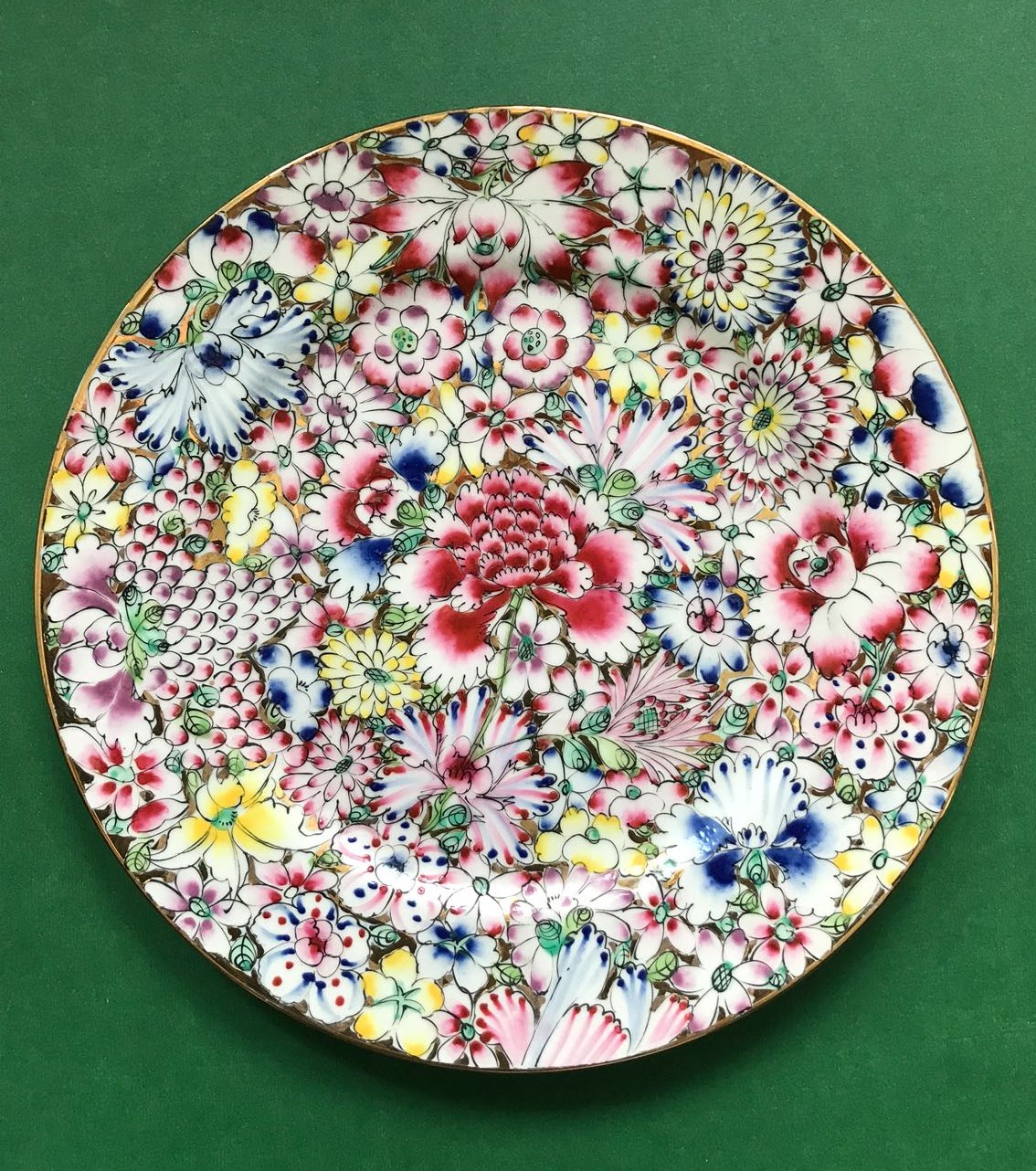
Covered tureen with figures in archaic Qianlong guangcai style. (1960s–1970s, painted by Master Lee Siu-hung; collection of Hong Kong Heritage Museum)Plate with millefleur design in guangcai style. (Produced by Ah Chow Factory; collection of Mdm Betty Ho
Saucer with double dragon design on yellow-ground and meander border in guangcai style. (1960s, painted by Yuet Tung China Works; collection of Hong Kong Heritage Museum)
The Artisanal Ecosystem in Hong Kong’s Chaoshan Practitioner Sector
Among the early local porcelain decorating factories dedicated primarily to the production of chaocai were Shing Fa and Luen Shing. Upon their arrival in Hong Kong, many painters from the Chaoshan region initially engaged in the overglaze decoration of restaurant tableware, such as dim sum dishes inscribed with numerals indicating prices or catering porcelain bearing the names of specific eateries. Nonetheless, the sector's leading figures frequently included individuals hailing from the Chaoshan region; for instance, the renowned master Lee Siu-man, celebrated for his fine-art porcelain painting, was a native of Shantou. Furthermore, a significant concentration of chaocai workshops was established early on in Holy Cross Path Village in Sai Wan Ho, serving as a hub where masters such as the brothers Ng Hak-lai and Ng Hak-shun (of Tung Kwong Lai Kee porcelain factory), Cheng Chak-yu, Yu Chak-shu, and So Siu-choy forged their early careers. So Siu-choy and several other Chaoshan masters later joined To Ngai Earthware, one of Hong Kong’s largest porcelain factories. Its founder, Liu Kam-choy, was a native of Chao'an, and all six of his children actively participated in the factory's production and management. Similarly, the painters recruited by Wah Tung comprised numerous talents originally from Chaoshan. At the Tao Fong Shan Christian Centre, Tse Chung-ng—a chaocai painter originally from Chao'an; who came to Hong Kong via Shantou—managed the centre’s porcelain painting workshop for nearly 40 years. Notably, the workshop also employed several Hakka painters from Meizhou, a prominent ceramic-producing region adjacent to Chaozhou. Due to the limitations of the compiled data, the extensive roster of other local chaocai factories and painters cannot be fully enumerated here.
Dim sum dish featuring overglaze numerals indicating prices, produced by artisans originally from the Chaoshan region. (Collection of Yuet Tung China Works)Porcelain dish with landscape design, produced during the tenure of Master Tse Chung-ng (a native of Chao'an) as supervisor of the porcelain painting workshop at the Tao Fong Shan Christian Centre. (Collection of the Tao Fong Shan Christian Centre)
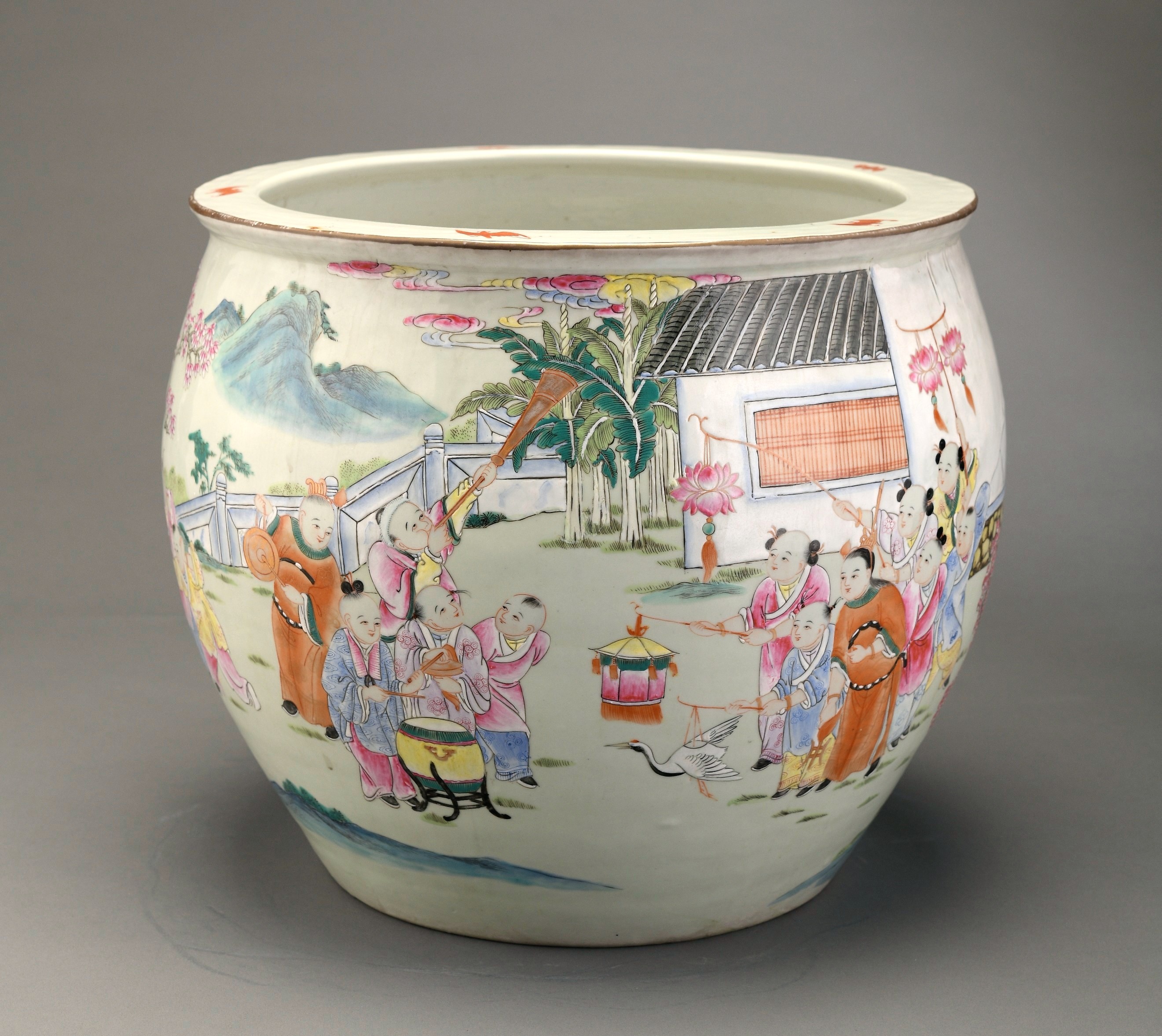
Fish tank painted in Tongzhi style with scene of children playing, by Master So Siu-choy during his employment at To Ngai Earthware: Both the master and the proprietor's family hailed from the Chaoshan region. (1980–1995; collection of Hong Kong Heritage Museum)
The Symbiosis of Varied Painted Porcelain Traditions
Upon their arrival in Hong Kong, practitioners representing distinct branches of the Guangdong painted porcelain system initially operated within their inherited areas of expertise. Over time, however, many transitioned into other realms of porcelain production, guided either by the contingencies of their professional trajectories or by the demands of the consumer market. The dynamic movements of diverse talents within the ecological network of Hong Kong painted porcelain yielded a highly subtle interplay. Characterized by technical collaboration and mutual exchange, these cross-currents became thoroughly intertwined, thereby endowing the stylistic repertoire of gangcai with remarkable diversity. On Hong Kong soil, instances of interaction between guangcai and chaocai practitioners were remarkably common. Research indicates that numerous chaocai painters joined the ranks of guangcai factories after migrating to Hong Kong, while many chaocai workshops eventually shifted their primary focus to guangcai production (whereas the reverse—guangcai workshops pivoting to chaocai—appears to have been rare). Furthermore, major local porcelain works often established multiple subsidiary workshops, assembling painters from various regional backgrounds and with distinct specialties to produce a range of porcelain wares that replicated nearly every imperial dynasty of China. A select group of painters possessing training in classical Chinese painting and calligraphy was also capable of rendering qianjiang ink wash painting porcelain or calligraphic porcelain imbued with the aesthetic sensibilities of literati painting. More significantly, senior painting masters transcended regional traits to cultivate idiosyncratic painting styles; some even synthesized disparate decoration techniques into a singular artistic vocabulary, blending water-based and oil-based pigments to execute multi-layered applications that masterfully generated exceptionally rich visual textures and tonal gradations.
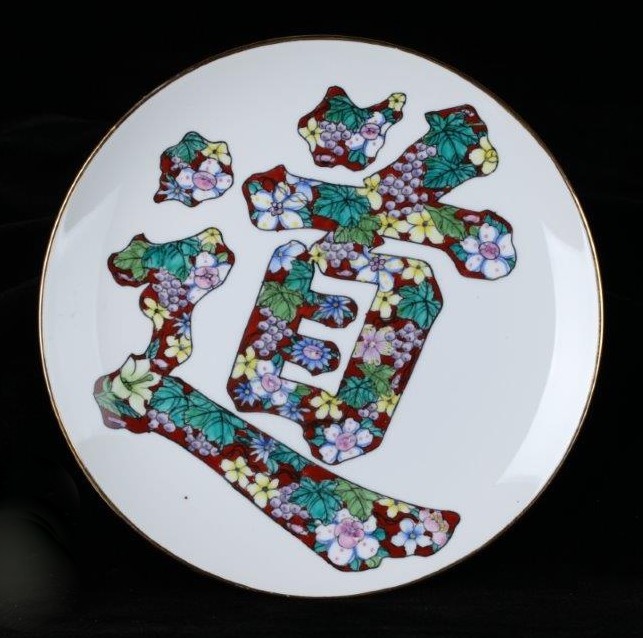
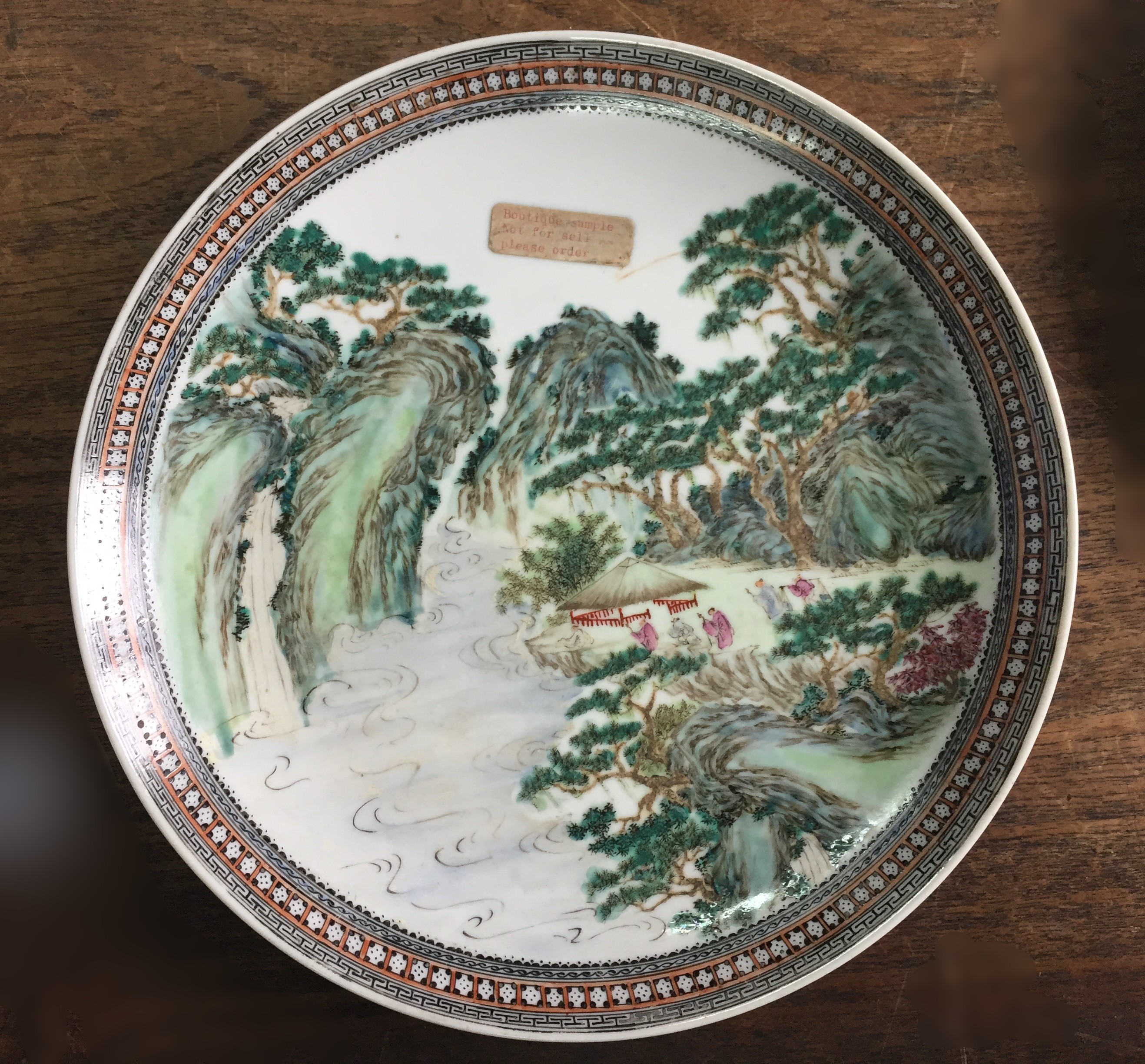
Guangcai dish with millefleur design and the Chinese character “道” (Dao):The Tao Fong Shan Christian Centre initially produced painted porcelain in the chaocai style, but subsequently integrated decorative elements from the guangcai repertoire, such as the millefleur design. (Collection of Tao Fong Shan Christian Centre)Plate with landscape and brocade border: Yuet Tung China Works, which specialised in producing Guangcai porcelain, attracted a wide range of skilled craftsmen in its early days, including painters who were particularly adept at painting Qianjang porcelain. (1950s, painted by Poon Chap Nga; collection of Yuet Tung China Works)
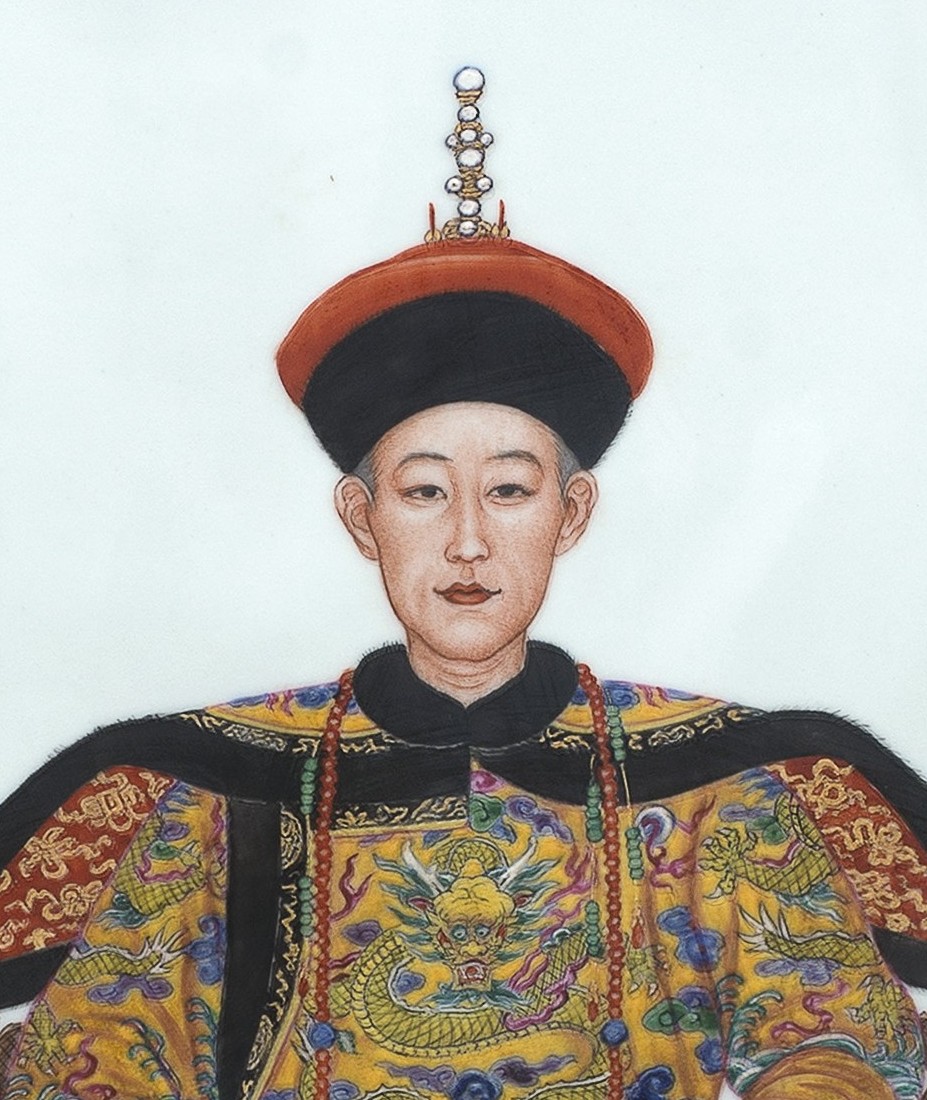
Plaque with portrait of Emperor Qianlong of the Qing dynasty (detail): Lee Siu-man, who originally worked in chaocai factory in Mainland, later moved to Hong Kong, where he mastered a technique that combined water-based and oil-based paints in multi-layered applications to create exceptionally rich visual textures and tonal gradations. (Late 1980s; collection of Hong Kong Heritage Museum)
Hong Kong as a Crucible of Diverse Painted Porcelain Techniques
Since its inception, gangcai was developed primarily for the export market, mirroring the historical trajectory of early Qing dynasty export porcelain, a portion of which was custom-made to foreign specifications. By the 20th century in Hong Kong, the tastes of foreign clientele continued to exert a direct influence on the categories of porcelain produced by local decorating factories and painters. Regardless of their regional origins, practitioners within the gangcai sector demonstrated remarkable commercial flexibility, executing bespoke orders to meet customer specifications and secure foreign exchange. Painters drawing upon their inherited mastery of traditional guangcai and chaocai styles, coupled with their independent experimentation with alternative decorative modalities, were highly adept at replicating Chinese porcelain from various imperial dynasties and diverse palette of painting decoration. Their virtuosity extended to foreign palettes, encompassing European Rococo styles as well as Japanese traditions such as Imari, Kutani, and Satsuma wares. When “thick-paint” (houcai, or thick-fencai) porcelain—detailed further in the section Fundamentals of Hong Kong Painted Porcelain Technology: Characteristic Production Techniques—emerged on the foundation of traditional fencai and attained widespread popularity, painters originally specializing in either guangcai or chaocai overwhelmingly joined this major stylistic movement. This trend first manifested in Hong Kong during the 1970s, with Wah Tung China serving as the forerunner; subsequently, nearly all other local painted porcelain factories actively committed themselves to the manufacture of houcai wares. During the peak era of the Hong Kong industry, enterprises that simultaneously deployed multiple overglaze decoration techniques included not only Wah Tung but also Chung Ah, To Ngai Earthware, Art Sheen, Wing Tai, To Tsu Kok, and United Wilson, among others. As the boundaries separating the specific decorative repertoires of these factories gradually blurred, local painted porcelain increasingly resembled a vast crucible, within which the unique artistic identity of gangcai became all the more pronounced.
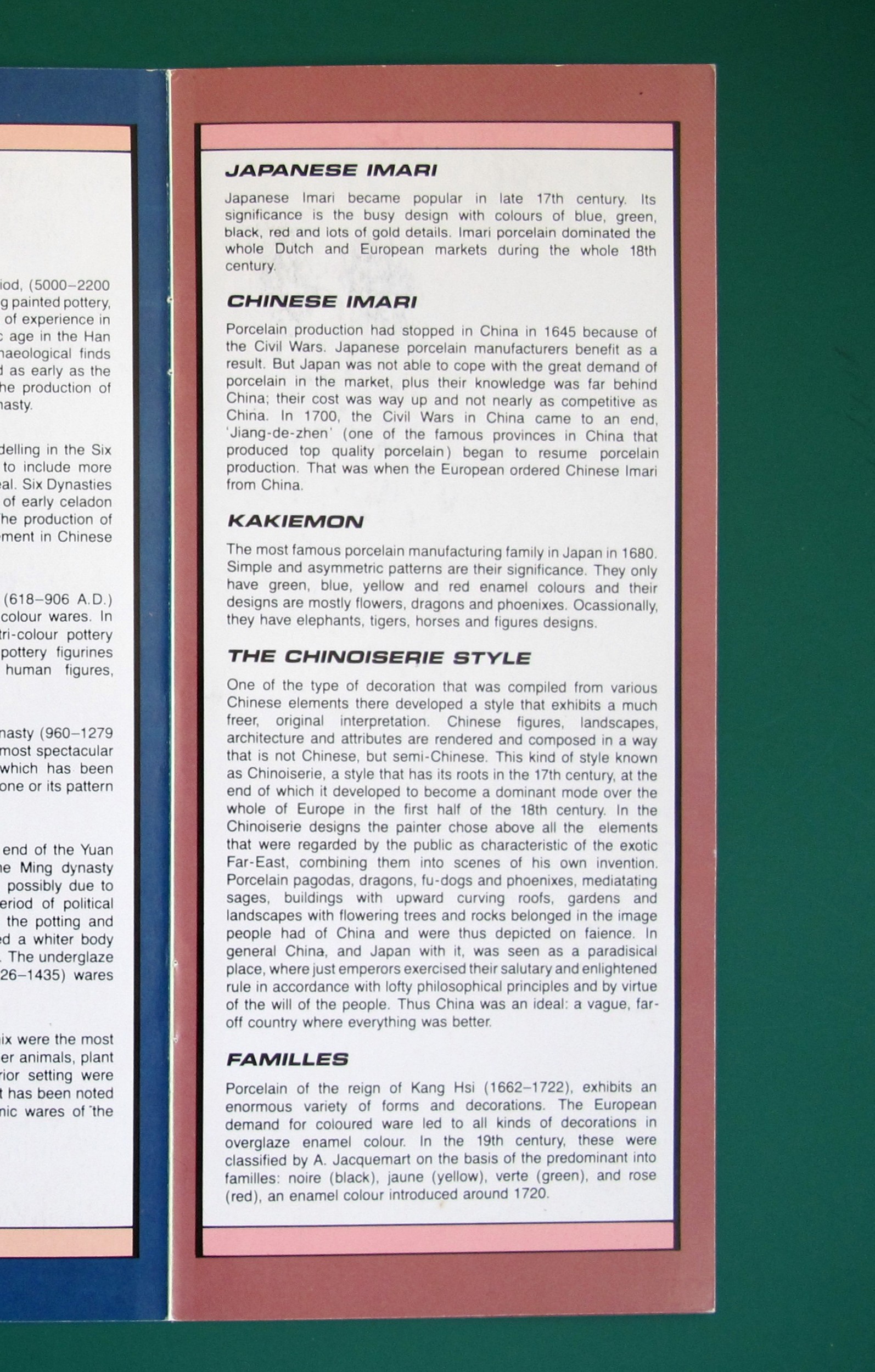
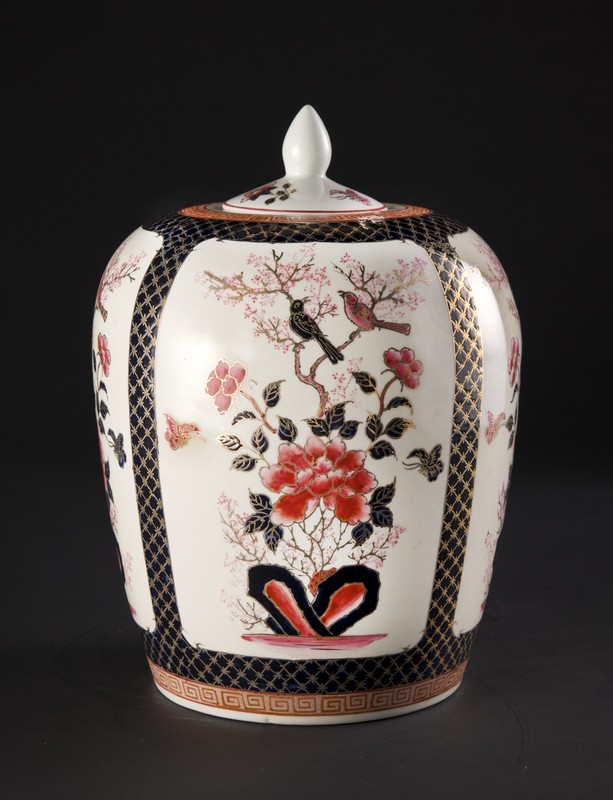
Promotional leaflet from Wah Tung China: The document enumerates a highly diverse product range, including Imari ware and Kakiemon ware in Japanese style and Sino-Japanese style, chinoiserie painted porcelain and reproductions of Kangxi period fencai porcelain. (Collection of Mr Ho Kwong-shing)Ginger jar with bird and floral design imitating Japanese Satsuma style: Master Lam Siu-wo originally specialized in Chinese painted porcelain, but subsequently adapted to shifting market trends by producing Japanese-styled wares. (1990; collection of Hong Kong Heritage Museum)
Sample porcelain plate with figure painting in the style of the Renaissance master Michelangelo: Master Tam Chi-hung, who was historically renowned for his mastery of traditional guangcai, was equally capable of executing Western-styled figurative paintings on porcelain in response to client demand. (1990; collection of Yuet Tung China Works)
The Artistic Accomplishments behind the Gangcai Painting Masters
The majority of the exceptionally gifted painting masters within the gangcai sector did not receive formal training from academic art institutions. Rather than limiting themselves to honing ceramic techniques solely for occupational requirements, they actively immersed themselves in artistic cultivation outside the industrial apparatus. This amateur practice subtly yet profoundly reshaped the aesthetic contour of their ceramic art.
Among the gangcai oral history interviewees, the most senior porcelain painting master, Chui Miu, is himself an ink painting artist who studied traditional Chinese painting through vocational training classes organized by The Evangelical Lutheran Church Social Service (Hong Kong) prior to entering the porcelain workshop. Lee Siu-man is likewise a painter, having studied traditional Chinese painting in his formative years under the famous ink painting master Bao Shao-you who had studied in Japan. Vong Vai-in, celebrated for his figural depictions, derived his foundational training from studying design and sketching at the Hong Kong Academy of Fine Arts. The ceramicist Cheung King dedicated himself to the art of calligraphy, excelling in the running script and regular script. Tam Chi-hung immersed himself in the ink-wash traditions of the Lingnan School, holding a particular admiration for the artist Deng Fen. Cheung Kam-ping, who was the principal artist responsible for sample prototyping at Wah Tung and designed countless patterns, laid his artistic foundation by studying sketching at the Macau Artist Society before migrating to Hong Kong. Chung Lap-kwan is a local prominent contemporary ink painter who, in his early years, studied under the renowned painting master Liu Kuo-sung through courses offered by the Department of Extramural Studies at The Chinese University of Hong Kong. Chou Yi-hung, who resided in Hong Kong for 18 years, was himself an acclaimed Chinese painting master adept at landscapes, florals, and figures; during his early career, he created a vast corpus of designs for the porcelain painting workshop of the Tao Fong Shan Christian Centre. Additionally, Ng Kee-ping and Poon Fei-ying worked as comic book illustrators before they joined Wah Tung. As these numerous cases demonstrate, an unceasing current of artistic vitality flowed behind the mechanical operations of industrial production, quietly imbuing gangcai with an enduring grace and aesthetic refinement.
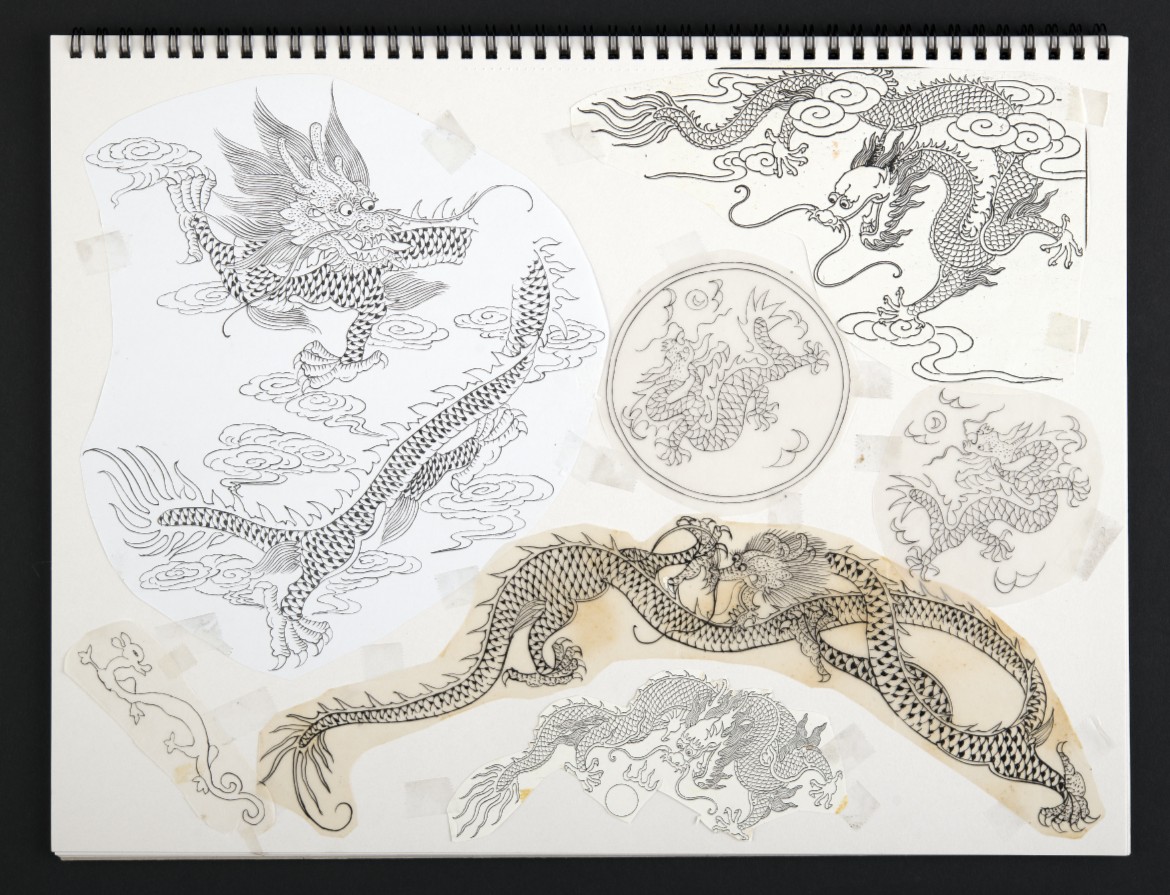
Master manuscript for export ware by Master Cheung Kam-ping: Scenes of fox hunting design. (1980s; private collection of the artist)Master manuscript for porcelain ware by Master Tam Chi-hung: Dragon designs. (1990–2001; collection of Yuet Tung China Works)
Painting reference materials utilized by Master Lee Siu-man. (Private collection of the artist)
The Broad Spectrum of Gangcai Categories
The aforementioned examples sufficiently illustrate how, within the open milieu of 20th-century Hong Kong, diverse painted porcelain traditions coexisted synthetically while embracing newly developed ceramic techniques. Consequently, when the shifting demands of the export market acted as a magnetic force steering the direction of production typologies, the Hong Kong painted porcelain sector was able to leverage a multifaceted pool of highly skilled talents to meet those requirements.
Whether adapting dynamically to changing circumstances or drawing upon the proactive courage to create new markets, porcelain painting factories flexibly adjusted their production lines. In tandem with the painters' continuous self-refinement in ceramic artistry, the classical cadences of traditional painted porcelain gave rise to brilliant variations. This interplay endowed the ceramic landscape of this small territory with an exceptionally broad spectrum, resulting in a remarkable and astonishing diversity of gangcai ware categories.
The Lineages of Gangcai Craft Traditions: Guangdong Painted Porcelain
The majority of the early painted porcelain artisans who migrated to Hong Kong inherited artistry rooted in Guangdong painted porcelain. Within this lineage, guangcai (廣彩) and chaocai (潮彩) emerged as the two primary mainstream traditions. The firing and painting techniques of both guangcai and chaocai have been inscribed onto China’s National List of Representative Items of Intangible Cultural Heritage (see project serial numbers 800 and 1332). Augmented by the developmental influence of the Jiangxi Jingdezhen painted porcelain tradition, alongside the novel elements introduced by local Hong Kong artisans, Hong Kong painted porcelain ultimately evolved into a crowning synthesis where diverse decorative traditions converged with local ingenuity.
Guangcai, or Guangzhou (Canton) painted porcelain, originated during the mid-to-late Kangxi reign of the Qing dynasty, reaching its peak during the Yongzheng and Qianlong eras. Chaocai, or Chaozhou (Teochew or Chiu Chow) painted porcelain, boasts a long historical standing; in a broad sense, it encompasses the painted porcelain produced since the Qing dynasty and the Republican period in Chaozhou, Guangdong Province, and its surrounding territories. Its geographical distribution spans Xiangqiao District and, Fengxi District, Chao’an (Teoann) County, and Raoping County within Chaozhou.
The guangcai and chaocai wares commonly observed in Hong Kong exhibit notable commonalities due to their intersecting and diverging historical trajectories, yet they simultaneously manifest highly distinct characteristics. The divergence between guangcai and chaocai can be broadly summarized into several key aspects: The quintessential composition of guangcai involves densely distributing patterns and motifs across the entire ceramic surface (filled ground or mandi). It opens window-like panels out of the brocade ground patterns (jindi kaiguang) and places the primary thematic motifs (huaxin) within these panels, yielding an intricate and magnificent visual effect. Conversely, the mainstream aesthetic of chaocai is relatively sparse, clear in its structural layering, and frequently adopts compositions characteristic of traditional painting styles. Regarding the application of color, guangcai pigments are predominantly mixed with water, utilizing an idiosyncratic method of preparation and a distinct color palette. Compared to famille rose (fencai), the fired colors of guangcai appear thinner, more translucent, and highly vibrant. The decorated surfaces retain a slightly tactile, uneven texture to the touch, with designs outlined in black lines before being filled with color. Chaocai, on the other hand, primarily employs oil as a mixing medium, with pigments consisting largely of imported Western colors (yangcai). The painted surface feels smooth to the touch, classified within the industry as “flat-painting” (pingcai). The motifs are outlined with black lines before being washed and shaded with color, evoking the expressive charm of Chinese freehand (xieyi) ink painting.
Although guangcai and chaocai each possess unique artistic merits, both inherited and subsequently adapted the painted porcelain artistry of Jiangxi throughout their historical evolution. Furthermore, both traditions manufactured painted porcelain imitative of the Kangxi and Qianlong periods, as well as the Jiaqing and Daoguang eras of the Qing dynasty. Coupled with the prevalent use of gold overglaze in both styles—creating “woven gold” (zhijin) and “raised gilding” (duijin) decorations respectively, which yield equally resplendent effects—the guangcai and chaocai pieces encountered in Hong Kong can sometimes be challenging to differentiate.
The Artisanal Ecosystem in Hong Kong’s Guangcai Sector
To understand the ecosystem of Hong Kong’s guangcai sector, one must first examine its porcelain painting factories. An overview of their early industrial production models reveals that they were profoundly influenced by the guangcai traditions of Guangzhou. This lineage is substantiated by cross-referencing the 1955 edition of the Wage scale for painting guangcai patterns issued by the Hong Kong and Kowloon Porcelain Painters’ Guild with the 1926 (the 15th year of the Republic) edition of the Wage scale compiled by the Guangdong Lingsi Tang Painted Porcelain Guild in Guangzhou; the nomenclature of traditional guangcai patterns recorded in both volumes exhibits a striking similarity.
During the nascent phase of the local industry, factories dedicated primarily to guangcai production included Kam Wah Loong Canton, Ah Chow Factory, Tung Fong, Kwong Yee Lung (a joint venture between the brothers Lee Ming and Lee Sum, and Wat Kau), Wing Lee Shing (or Lee Hung Kee), Wing Hing, Wing Shun Lung and Chun Wah Lung. Moreover, there were guangcai factories located on the Peng Chau island, including Kwong Yee Lung (distinct from the aforementioned factory of the same name; and later transferred to the ownership of Wah Lei), Chun Lung Sing, and Wang Hing, among others. Subsequently, Kam Wah Loong Canton was renamed Yuet Tung China Works, steered successively by three generations of the Tso family. Lee Wing-chiu, the son of Wing Lee Shing’s proprietor Lee Siu-hung, founded An Tai; the descendants of Ah Chow Factory’s founder, Koo Hoi-ming (alternatively cited as Koo Hon-ming), established Overjoy; and the successor of Wing Hing’s proprietor, Szeto Wai-tak, founded Wing Tai. Augmented by later newcomers such as Chiu Kee on Peng Chau, the transmission of guangcai craftsmanship formed an unbroken lineage.
The locality boasted a multitude of painting masters specializing in guangcai, including Chan King-ho, Lee Wing-chiu, Szeto Chan-shing, Luk Chau, Sin Cheong-lun, Li Cho-nam, Chung Wai-ying, Wong Nin, Ho Leung, Mak Kam-cho, Tam Chi-hung, Lam Chak-ting, Lam Hon-chiu, Szeto Biu, and Lam Siu-wo, each possessing unique expertise in specific decorative motifs. Given the vast scale of the craft, the roster of painters and porcelain factories listed on the gangcai archive represents but a fraction of the historical reality.
The classic, traditional designs of guangcai remained perennial staples for local factories, with production spanning the entire 20th century. Beyond producing the classical standard items (as enumerated in the Wage scale), local factories also manufactured “antique guangcai reproductions” during the initial stages of the local industry's development, spurred by demand from Western antiquarians. For instance, Lee Siu-hung, a painter active in Henan in Guangzhou who was lauded as the “Champion Scholar of Painted Porcelain”, was reputed for his superb skills in creating imitations of antique guangcai; Vong Vai-in, the proprietor of Chung Ah, focused primarily on producing porcelain items in Daoguang and Tongzhi style during the factory's formative years; Ho Kwong-shing, the founder of Wah Tung China, initially produced porcelain plaque with figures painted after Tongzhi style. Similarly, Cheng Ping, the earliest painting master employed by Art Sheen, excelled in painting highly authentic recreations of the Kangxi porcelain.
Covered tureen with figures in archaic Qianlong guangcai style. (1960s–1970s, painted by Master Lee Siu-hung; collection of Hong Kong Heritage Museum)Plate with millefleur design in guangcai style. (Produced by Ah Chow Factory; collection of Mdm Betty Ho
Saucer with double dragon design on yellow-ground and meander border in guangcai style. (1960s, painted by Yuet Tung China Works; collection of Hong Kong Heritage Museum)
The Artisanal Ecosystem in Hong Kong’s Chaoshan Practitioner Sector
Among the early local porcelain decorating factories dedicated primarily to the production of chaocai were Shing Fa and Luen Shing. Upon their arrival in Hong Kong, many painters from the Chaoshan region initially engaged in the overglaze decoration of restaurant tableware, such as dim sum dishes inscribed with numerals indicating prices or catering porcelain bearing the names of specific eateries. Nonetheless, the sector's leading figures frequently included individuals hailing from the Chaoshan region; for instance, the renowned master Lee Siu-man, celebrated for his fine-art porcelain painting, was a native of Shantou. Furthermore, a significant concentration of chaocai workshops was established early on in Holy Cross Path Village in Sai Wan Ho, serving as a hub where masters such as the brothers Ng Hak-lai and Ng Hak-shun (of Tung Kwong Lai Kee porcelain factory), Cheng Chak-yu, Yu Chak-shu, and So Siu-choy forged their early careers. So Siu-choy and several other Chaoshan masters later joined To Ngai Earthware, one of Hong Kong’s largest porcelain factories. Its founder, Liu Kam-choy, was a native of Chao'an, and all six of his children actively participated in the factory's production and management. Similarly, the painters recruited by Wah Tung comprised numerous talents originally from Chaoshan. At the Tao Fong Shan Christian Centre, Tse Chung-ng—a chaocai painter originally from Chao'an; who came to Hong Kong via Shantou—managed the centre’s porcelain painting workshop for nearly 40 years. Notably, the workshop also employed several Hakka painters from Meizhou, a prominent ceramic-producing region adjacent to Chaozhou. Due to the limitations of the compiled data, the extensive roster of other local chaocai factories and painters cannot be fully enumerated here.
Dim sum dish featuring overglaze numerals indicating prices, produced by artisans originally from the Chaoshan region. (Collection of Yuet Tung China Works)Porcelain dish with landscape design, produced during the tenure of Master Tse Chung-ng (a native of Chao'an) as supervisor of the porcelain painting workshop at the Tao Fong Shan Christian Centre. (Collection of the Tao Fong Shan Christian Centre)
Fish tank painted in Tongzhi style with scene of children playing, by Master So Siu-choy during his employment at To Ngai Earthware: Both the master and the proprietor's family hailed from the Chaoshan region. (1980–1995; collection of Hong Kong Heritage Museum)
The Symbiosis of Varied Painted Porcelain Traditions
Upon their arrival in Hong Kong, practitioners representing distinct branches of the Guangdong painted porcelain system initially operated within their inherited areas of expertise. Over time, however, many transitioned into other realms of porcelain production, guided either by the contingencies of their professional trajectories or by the demands of the consumer market. The dynamic movements of diverse talents within the ecological network of Hong Kong painted porcelain yielded a highly subtle interplay. Characterized by technical collaboration and mutual exchange, these cross-currents became thoroughly intertwined, thereby endowing the stylistic repertoire of gangcai with remarkable diversity. On Hong Kong soil, instances of interaction between guangcai and chaocai practitioners were remarkably common. Research indicates that numerous chaocai painters joined the ranks of guangcai factories after migrating to Hong Kong, while many chaocai workshops eventually shifted their primary focus to guangcai production (whereas the reverse—guangcai workshops pivoting to chaocai—appears to have been rare). Furthermore, major local porcelain works often established multiple subsidiary workshops, assembling painters from various regional backgrounds and with distinct specialties to produce a range of porcelain wares that replicated nearly every imperial dynasty of China. A select group of painters possessing training in classical Chinese painting and calligraphy was also capable of rendering qianjiang ink wash painting porcelain or calligraphic porcelain imbued with the aesthetic sensibilities of literati painting. More significantly, senior painting masters transcended regional traits to cultivate idiosyncratic painting styles; some even synthesized disparate decoration techniques into a singular artistic vocabulary, blending water-based and oil-based pigments to execute multi-layered applications that masterfully generated exceptionally rich visual textures and tonal gradations.
Guangcai dish with millefleur design and the Chinese character “道” (Dao):The Tao Fong Shan Christian Centre initially produced painted porcelain in the chaocai style, but subsequently integrated decorative elements from the guangcai repertoire, such as the millefleur design. (Collection of Tao Fong Shan Christian Centre)Plate with landscape and brocade border: Yuet Tung China Works, which specialised in producing Guangcai porcelain, attracted a wide range of skilled craftsmen in its early days, including painters who were particularly adept at painting Qianjang porcelain. (1950s, painted by Poon Chap Nga; collection of Yuet Tung China Works)
Plaque with portrait of Emperor Qianlong of the Qing dynasty (detail): Lee Siu-man, who originally worked in chaocai factory in Mainland, later moved to Hong Kong, where he mastered a technique that combined water-based and oil-based paints in multi-layered applications to create exceptionally rich visual textures and tonal gradations. (Late 1980s; collection of Hong Kong Heritage Museum)
Hong Kong as a Crucible of Diverse Painted Porcelain Techniques
Since its inception, gangcai was developed primarily for the export market, mirroring the historical trajectory of early Qing dynasty export porcelain, a portion of which was custom-made to foreign specifications. By the 20th century in Hong Kong, the tastes of foreign clientele continued to exert a direct influence on the categories of porcelain produced by local decorating factories and painters. Regardless of their regional origins, practitioners within the gangcai sector demonstrated remarkable commercial flexibility, executing bespoke orders to meet customer specifications and secure foreign exchange. Painters drawing upon their inherited mastery of traditional guangcai and chaocai styles, coupled with their independent experimentation with alternative decorative modalities, were highly adept at replicating Chinese porcelain from various imperial dynasties and diverse palette of painting decoration. Their virtuosity extended to foreign palettes, encompassing European Rococo styles as well as Japanese traditions such as Imari, Kutani, and Satsuma wares. When “thick-paint” (houcai, or thick-fencai) porcelain—detailed further in the section Fundamentals of Hong Kong Painted Porcelain Technology: Characteristic Production Techniques—emerged on the foundation of traditional fencai and attained widespread popularity, painters originally specializing in either guangcai or chaocai overwhelmingly joined this major stylistic movement. This trend first manifested in Hong Kong during the 1970s, with Wah Tung China serving as the forerunner; subsequently, nearly all other local painted porcelain factories actively committed themselves to the manufacture of houcai wares. During the peak era of the Hong Kong industry, enterprises that simultaneously deployed multiple overglaze decoration techniques included not only Wah Tung but also Chung Ah, To Ngai Earthware, Art Sheen, Wing Tai, To Tsu Kok, and United Wilson, among others. As the boundaries separating the specific decorative repertoires of these factories gradually blurred, local painted porcelain increasingly resembled a vast crucible, within which the unique artistic identity of gangcai became all the more pronounced.
Promotional leaflet from Wah Tung China: The document enumerates a highly diverse product range, including Imari ware and Kakiemon ware in Japanese style and Sino-Japanese style, chinoiserie painted porcelain and reproductions of Kangxi period fencai porcelain. (Collection of Mr Ho Kwong-shing)Ginger jar with bird and floral design imitating Japanese Satsuma style: Master Lam Siu-wo originally specialized in Chinese painted porcelain, but subsequently adapted to shifting market trends by producing Japanese-styled wares. (1990; collection of Hong Kong Heritage Museum)
Sample porcelain plate with figure painting in the style of the Renaissance master Michelangelo: Master Tam Chi-hung, who was historically renowned for his mastery of traditional guangcai, was equally capable of executing Western-styled figurative paintings on porcelain in response to client demand. (1990; collection of Yuet Tung China Works)
The Artistic Accomplishments behind the Gangcai Painting Masters
The majority of the exceptionally gifted painting masters within the gangcai sector did not receive formal training from academic art institutions. Rather than limiting themselves to honing ceramic techniques solely for occupational requirements, they actively immersed themselves in artistic cultivation outside the industrial apparatus. This amateur practice subtly yet profoundly reshaped the aesthetic contour of their ceramic art.
Among the gangcai oral history interviewees, the most senior porcelain painting master, Chui Miu, is himself an ink painting artist who studied traditional Chinese painting through vocational training classes organized by The Evangelical Lutheran Church Social Service (Hong Kong) prior to entering the porcelain workshop. Lee Siu-man is likewise a painter, having studied traditional Chinese painting in his formative years under the famous ink painting master Bao Shao-you who had studied in Japan. Vong Vai-in, celebrated for his figural depictions, derived his foundational training from studying design and sketching at the Hong Kong Academy of Fine Arts. The ceramicist Cheung King dedicated himself to the art of calligraphy, excelling in the running script and regular script. Tam Chi-hung immersed himself in the ink-wash traditions of the Lingnan School, holding a particular admiration for the artist Deng Fen. Cheung Kam-ping, who was the principal artist responsible for sample prototyping at Wah Tung and designed countless patterns, laid his artistic foundation by studying sketching at the Macau Artist Society before migrating to Hong Kong. Chung Lap-kwan is a local prominent contemporary ink painter who, in his early years, studied under the renowned painting master Liu Kuo-sung through courses offered by the Department of Extramural Studies at The Chinese University of Hong Kong. Chou Yi-hung, who resided in Hong Kong for 18 years, was himself an acclaimed Chinese painting master adept at landscapes, florals, and figures; during his early career, he created a vast corpus of designs for the porcelain painting workshop of the Tao Fong Shan Christian Centre. Additionally, Ng Kee-ping and Poon Fei-ying worked as comic book illustrators before they joined Wah Tung. As these numerous cases demonstrate, an unceasing current of artistic vitality flowed behind the mechanical operations of industrial production, quietly imbuing gangcai with an enduring grace and aesthetic refinement.
Master manuscript for export ware by Master Cheung Kam-ping: Scenes of fox hunting design. (1980s; private collection of the artist)Master manuscript for porcelain ware by Master Tam Chi-hung: Dragon designs. (1990–2001; collection of Yuet Tung China Works)
Painting reference materials utilized by Master Lee Siu-man. (Private collection of the artist)
The Broad Spectrum of Gangcai Categories
The aforementioned examples sufficiently illustrate how, within the open milieu of 20th-century Hong Kong, diverse painted porcelain traditions coexisted synthetically while embracing newly developed ceramic techniques. Consequently, when the shifting demands of the export market acted as a magnetic force steering the direction of production typologies, the Hong Kong painted porcelain sector was able to leverage a multifaceted pool of highly skilled talents to meet those requirements.
Whether adapting dynamically to changing circumstances or drawing upon the proactive courage to create new markets, porcelain painting factories flexibly adjusted their production lines. In tandem with the painters' continuous self-refinement in ceramic artistry, the classical cadences of traditional painted porcelain gave rise to brilliant variations. This interplay endowed the ceramic landscape of this small territory with an exceptionally broad spectrum, resulting in a remarkable and astonishing diversity of gangcai ware categories.