The painted porcelain industry has developed a number of unique techniques based on the characteristics of different materials and market demands. These are briefly outlined below:
1. Image Transfer
To produce multiple pieces of porcelain wares with the same pattern, it is traditional to transfer the pattern outlined with ink onto a blank, then colouring over the transferred ink guidelines with paint. The technique involved pressing the paper firmly with the palm of the hand from the reverse side to ensure the lines were transferred as clearly as possible. The outline must be drawn with thickened ink; a single piece of well-prepared paper could be used to transfer twenty to thirty times. During firing, the ink in the lines would vaporise and disappear from the high temperature, whilst the paint would be fired into the porcelain.
(Supplied by The Hong Kong Ceramics Research Society)
2. Tracing Circle
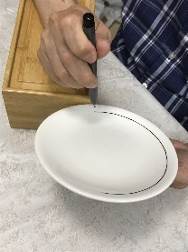
This is a technique for drawing circles on blanks, and is an elementary skill that everyone in the trade must acquire. Using the traditional method, the painting master can trace a circle with consistent lines on a porcelain piece simply by working with bare hands or resting the hand on a pillow box, without relying on any machinery or turntable. The method involves using the fingers of one hand to support the base of a round plate whilst turn it with the wrist, while the other hand holds a brush pen dipped with paint, with the tip placed at a suitable place or near the rim of the plate. As the plate rotates whilst the brush pen remains stationary, a circle is drawn. This method can be used to paint borders and concentric circles on a blank.
Tracing circle with a hand resting on a pillow box (supplied by the Hong Kong Ceramics Research Society)Tracing circle with bare hands (supplied by the Hong Kong Ceramics Research Society)
3. Spreading Paint
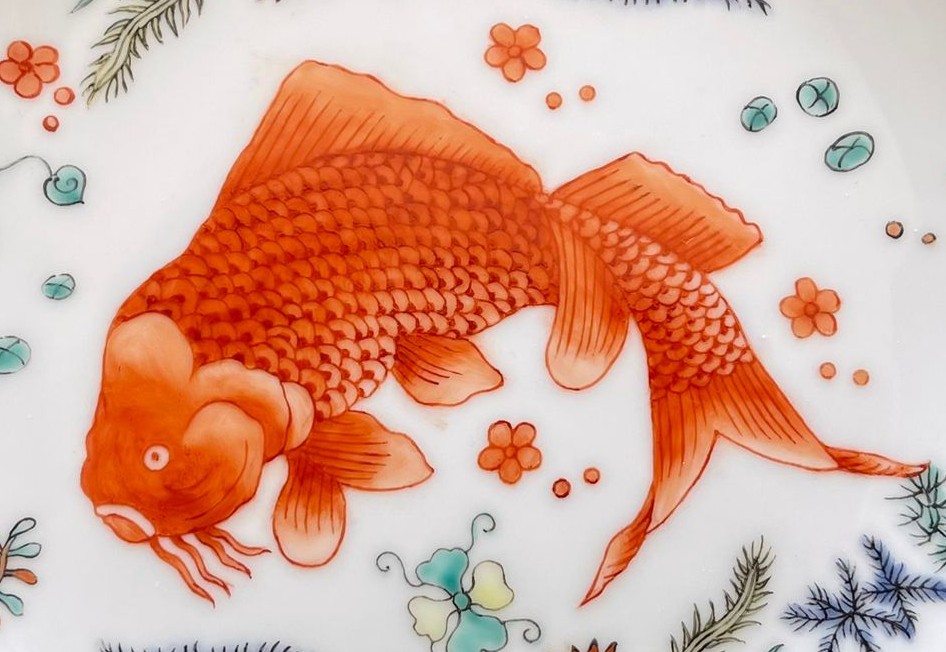
This is a porcelain painting technique used to create a gradient of colours. It requires controlling two brushes: one for dipping and applying paint, the other for spreading out the paint. Skilled painting masters can hold both brushes with one hand like a cross to rapidly switch between the two. The glazed surface of porcelain is too smooth for the paint to stick on easily, so it is more difficult to paint the porcelain compared to painting on paper, making this technique even more challenging.
Example of spread paint: plate with koi – the gradient effects in the head, body and fins of the fish were made with the spreading paint technique (painted and collected by Betty Ho)The way to grip the brushes for spreading paint (supplied by the Hong Kong Ceramics Research Society)
4. Freehand Flower
This is a distinctive technique used in painted porcelain to draw flowers, reminiscent of the freehand brushwork in traditional Chinese ink wash painting. When painting each petal, no outline is needed; the brushstrokes are executed with a single free, fluid and unbroken motion. The petals must exhibit light and shadow and rich layering, this requires competent technical skill. Rose created this way is the most exemplary, known as Canton Rose, it is typically painted using Chinese Purple of Cassius containing colloidal gold and is a classic traditional Guangcai motif. In addition to roses, it is also used to draw peonies and chrysanthemums.
Example of Freehand Flower: Plate with flora and fauna in guangcai style (part) – Canton Rose with light and shadow and rich layering (painted and collected by Cheung Kam Ping)
5. Thick Glaze
Thick glaze is a type of famille rose painted porcelain. By adjusting the pigment formula or mixing it with additives to thicken the paint, the patterns appear uneven in thickness after firing, feeling like carved when touched; this decorative effect is known as thick glaze. During the period when thick glaze was particularly sought after, it became its own category of painted porcelain. Each porcelain factory in Hong Kong had its own signature formulation; some mix chalk powder into the mix, some even used cigarette ash. To facilitate the application of the thickened paint, after the outlines were drawn, charcoal soot would be applied onto the outlines, followed by a coat of kerosene before colouring. This method allowed the black lines to absorb the oil-based additives fully, acting like barriers. As the paint used is water-based, it would be repelled by the oil-based black lines, so the outlines appeared crisp and distinct, whilst the water-based paints rise with surface tension, allowing them to build up with rich texture.
A comparison of thin and thick glaze (supplied by The Hong Kong Ceramics Research Society):
Colouring in guangcai is predominantly thin and translucent (painted by Chan King Ho)Applying thick glaze on antique style blank enhances the effect further (vintage houcai painted porcelain by An Tai)
6. Distressing
Painted porcelain wares just fired look glossy, disliked by those who wish to make antique replicas. To create the aged appearance of an artefact from the past, the industry often distresses the surface of the porcelain to give it a dull, aged look. Common methods include rubbing it with sandpaper, smear with corrosive ammonium fluoride or hydrofluoric acid, applying potassium permanganate, shellac, bitumen, earth, or charcoal soot, using imported distressing agent. The traditional method involves boiling chestnut shells in water until the liquid turns black and oily, then immersing the painted porcelain in it until it becomes yellowed, before using sandpaper smooth out any imperfections.
Example of distress: antique replica by Wah Tung, famed for the realistic and durable effect. (supplied by The Hong Kong Ceramics Research Society)
The painted porcelain industry has developed a number of unique techniques based on the characteristics of different materials and market demands. These are briefly outlined below:
1. Image Transfer
To produce multiple pieces of porcelain wares with the same pattern, it is traditional to transfer the pattern outlined with ink onto a blank, then colouring over the transferred ink guidelines with paint. The technique involved pressing the paper firmly with the palm of the hand from the reverse side to ensure the lines were transferred as clearly as possible. The outline must be drawn with thickened ink; a single piece of well-prepared paper could be used to transfer twenty to thirty times. During firing, the ink in the lines would vaporise and disappear from the high temperature, whilst the paint would be fired into the porcelain.
(Supplied by The Hong Kong Ceramics Research Society)
2. Tracing Circle
This is a technique for drawing circles on blanks, and is an elementary skill that everyone in the trade must acquire. Using the traditional method, the painting master can trace a circle with consistent lines on a porcelain piece simply by working with bare hands or resting the hand on a pillow box, without relying on any machinery or turntable. The method involves using the fingers of one hand to support the base of a round plate whilst turn it with the wrist, while the other hand holds a brush pen dipped with paint, with the tip placed at a suitable place or near the rim of the plate. As the plate rotates whilst the brush pen remains stationary, a circle is drawn. This method can be used to paint borders and concentric circles on a blank.
Tracing circle with a hand resting on a pillow box (supplied by the Hong Kong Ceramics Research Society)Tracing circle with bare hands (supplied by the Hong Kong Ceramics Research Society)
3. Spreading Paint
This is a porcelain painting technique used to create a gradient of colours. It requires controlling two brushes: one for dipping and applying paint, the other for spreading out the paint. Skilled painting masters can hold both brushes with one hand like a cross to rapidly switch between the two. The glazed surface of porcelain is too smooth for the paint to stick on easily, so it is more difficult to paint the porcelain compared to painting on paper, making this technique even more challenging.
Example of spread paint: plate with koi – the gradient effects in the head, body and fins of the fish were made with the spreading paint technique (painted and collected by Betty Ho)The way to grip the brushes for spreading paint (supplied by the Hong Kong Ceramics Research Society)
4. Freehand Flower
This is a distinctive technique used in painted porcelain to draw flowers, reminiscent of the freehand brushwork in traditional Chinese ink wash painting. When painting each petal, no outline is needed; the brushstrokes are executed with a single free, fluid and unbroken motion. The petals must exhibit light and shadow and rich layering, this requires competent technical skill. Rose created this way is the most exemplary, known as Canton Rose, it is typically painted using Chinese Purple of Cassius containing colloidal gold and is a classic traditional Guangcai motif. In addition to roses, it is also used to draw peonies and chrysanthemums.
Example of Freehand Flower: Plate with flora and fauna in guangcai style (part) – Canton Rose with light and shadow and rich layering (painted and collected by Cheung Kam Ping)
5. Thick Glaze
Thick glaze is a type of famille rose painted porcelain. By adjusting the pigment formula or mixing it with additives to thicken the paint, the patterns appear uneven in thickness after firing, feeling like carved when touched; this decorative effect is known as thick glaze. During the period when thick glaze was particularly sought after, it became its own category of painted porcelain. Each porcelain factory in Hong Kong had its own signature formulation; some mix chalk powder into the mix, some even used cigarette ash. To facilitate the application of the thickened paint, after the outlines were drawn, charcoal soot would be applied onto the outlines, followed by a coat of kerosene before colouring. This method allowed the black lines to absorb the oil-based additives fully, acting like barriers. As the paint used is water-based, it would be repelled by the oil-based black lines, so the outlines appeared crisp and distinct, whilst the water-based paints rise with surface tension, allowing them to build up with rich texture.
A comparison of thin and thick glaze (supplied by The Hong Kong Ceramics Research Society):
Colouring in guangcai is predominantly thin and translucent (painted by Chan King Ho)Applying thick glaze on antique style blank enhances the effect further (vintage houcai painted porcelain by An Tai)
6. Distressing
Painted porcelain wares just fired look glossy, disliked by those who wish to make antique replicas. To create the aged appearance of an artefact from the past, the industry often distresses the surface of the porcelain to give it a dull, aged look. Common methods include rubbing it with sandpaper, smear with corrosive ammonium fluoride or hydrofluoric acid, applying potassium permanganate, shellac, bitumen, earth, or charcoal soot, using imported distressing agent. The traditional method involves boiling chestnut shells in water until the liquid turns black and oily, then immersing the painted porcelain in it until it becomes yellowed, before using sandpaper smooth out any imperfections.
Example of distress: antique replica by Wah Tung, famed for the realistic and durable effect. (supplied by The Hong Kong Ceramics Research Society)