There are many tools used in gangcai, specialised tools include: charcoal kiln, pillow box, liner brush, compass and mandrel. These simple tools of trade of the painting masters reflect the wisdom of the crowd.
1. Charcoal kiln
In the early days, the electricity supply in Hong Kong was primitive and electric kilns were not common, it was typical to continue using the traditional method of firing porcelain in charcoal kilns as passed down from the Qing Dynasty. A charcoal kiln was cylindrical with an inner and an outer ring on the wall. Painted porcelain pieces were loaded on racks in the inner ring, charcoals mostly in the form of long sticks were placed between the two rings. During firing, the charcoals only indirectly heat up the porcelain pieces. Throughout the firing process, the kiln master must constantly monitor the colour of the flames to know the temperature in the kiln and to maintain the fire with more charcoal. Once the target temperature is reached, the leading kiln master works with colleagues to rake away the charcoal as quickly as possible to cool the kiln, so as not to affect the development of the glaze; the firing process is very tiring.
As electricity supply developed, electric kilns gradually became common, which the operation and temperature can be controlled by electronic thermostats, no longer require the toiling labours of the workers, charcoal kilns thus fell into decline. There were two main early manufacturers of electric kilns: one was a ceramics factory in Pun Chun Yuen at Tai Po, run by Szeto Wai Tak and his son (his son, Szeto Wing Chuen, later founded Wing Tai); the other was Hung Cheung in Fung Kat Heung at Kam Tin, run by Lung Kam Hung and his son, Lung Siu Hong.
Electric kiln (trolley type). (Made by Hung Cheung for An Tai. Photo from collection of Lee Wing Chiu)
2. Pillow Box
This is a small box for storing porcelain painting tools, also used as a handrest whilst painting with a brush. The box has a sliding lid for opening, when painting porcelain, the painting master rests his hand holding the brush on the lid, with the porcelain piece placed beneath it, thus preventing the hand from touching the porcelain surface and smudging the design. One corner of the resting box has a small recess for holding the pieces being painted, allowing for a smooth and even outline.
(Left) Pillow box (Right) Recess at a corning of the pillow box (Supplied by The Hong Kong Ceramics Research Society)
3. Liner Brush
This type of brush was originally used to decorate wooden clogs; due to its fine, firm bristles, it came to be used for outlining on porcelain. As the tip wears out easily, it would be a waste to discard the entire brush; therefore, to make the most of the handle, the tip was designed to be easily attached and removed.
Liner brush attached to the handle of a normal brush pen. (Supplied by The Hong Kong Ceramics Research Society)
4. Ink Marker
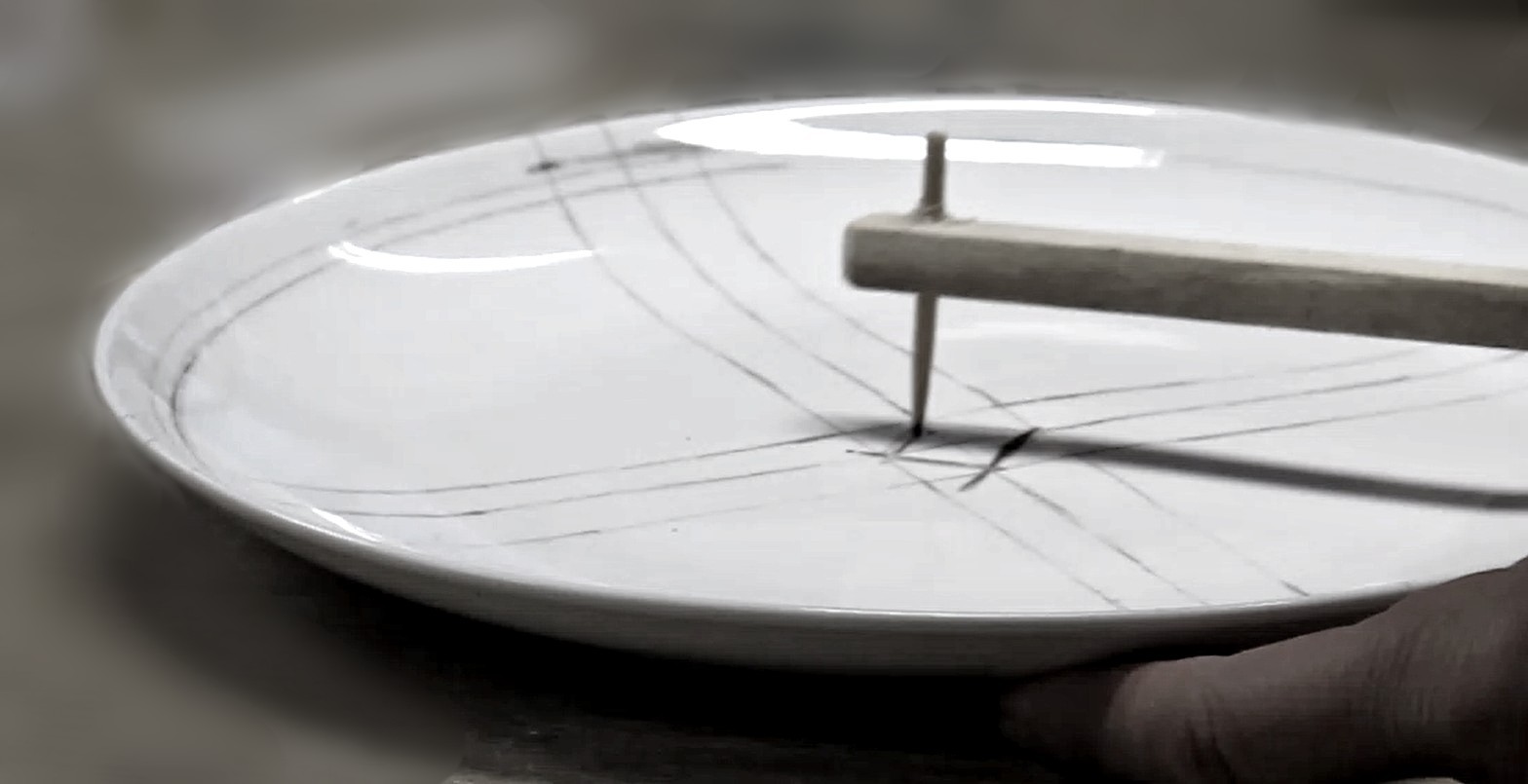
This is a tool used to mark reference points on blanks for outlining. It can be used to mark the centre point of a plate, the position to draw border, or the location of guide lines on a vase, for example. It is made by drilling several holes into a wooden stick or chopstick for inserting toothpicks. To mark a point, insert a toothpick into the hole at the suitable distance, then dip the tip of the toothpick in ink. Holding the ink marker in one hand whilst resting the other against one end of the porcelain ware allows you to mark the blank.
(Supplied by The Hong Kong Ceramics Research Soceity)
5. Compass
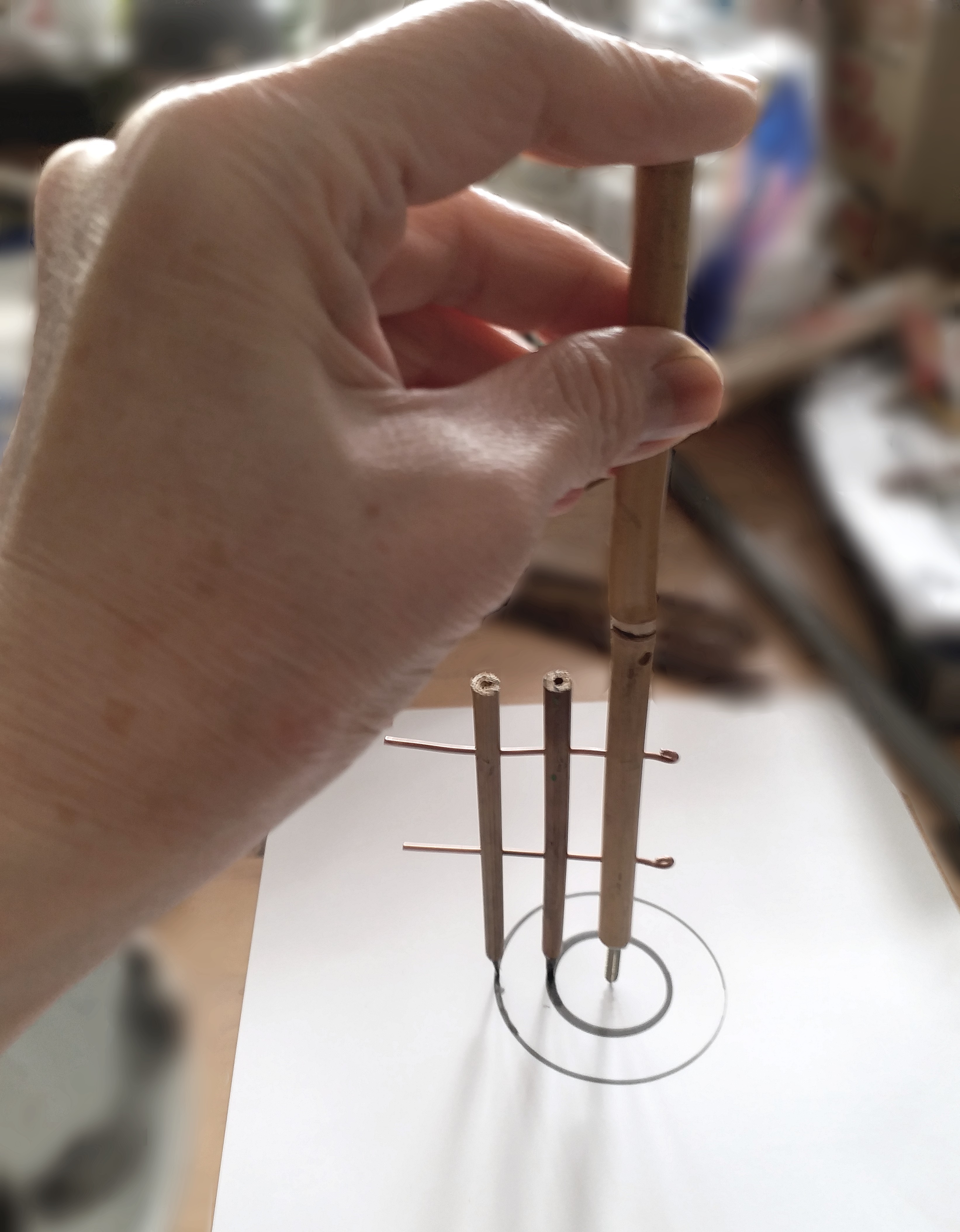
The compass is used for drawing circles on porcelain plates. The vertical shafts are made from bamboo, wood or chopsticks, with a needle attached to its lower end. Two balanced crossbars extend from the main shaft; a short brush pen with holes drilled is fitted onto these crossbars, and the brush pen can be moved along them to draw circles of different sizes. Simply place the needle on the centre of the plate, dip the brush pen in paint, hold the top of the shaft and rotate it to draw a circle. By attaching multiple brush pens, multiple concentric circles can be drawn at once.
(Supplied by The Hong Kong Ceramics Research Soceity)
6. Mandrel
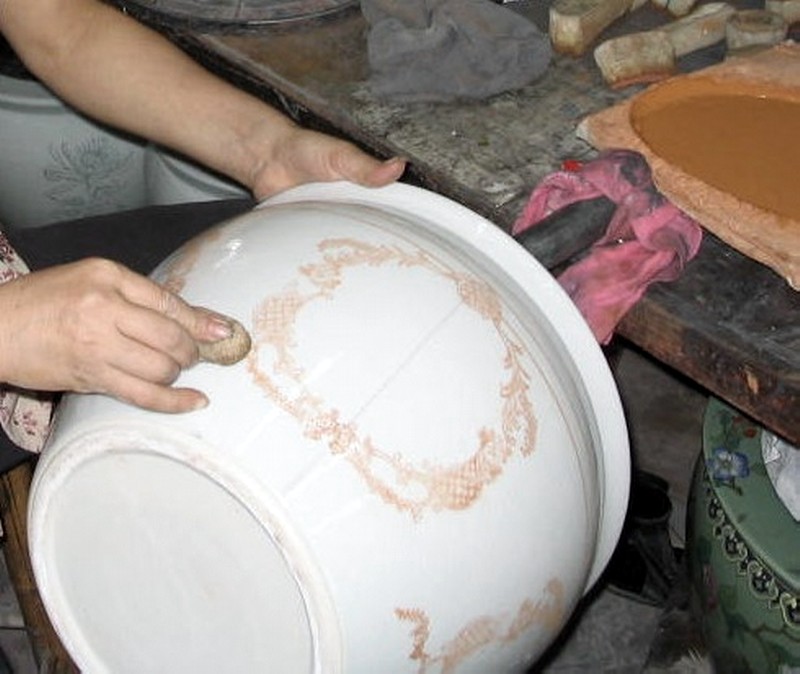
It is use to porcelain bottles and jars whilst painting. Secure a rod to a workbench, stool or wooden board, then slide the jar or bottle onto the rod horizontally to begin painting. As jars and bottles have curved surfaces, they are difficult to paint when standing upright, and the paint tends to drip downwards. With a mandrel, you can easily rotate the jar or bottle to paint different sections, whilst also controlling the flow of the paint.
There are many tools used in gangcai, specialised tools include: charcoal kiln, pillow box, liner brush, compass and mandrel. These simple tools of trade of the painting masters reflect the wisdom of the crowd.
1. Charcoal kiln
In the early days, the electricity supply in Hong Kong was primitive and electric kilns were not common, it was typical to continue using the traditional method of firing porcelain in charcoal kilns as passed down from the Qing Dynasty. A charcoal kiln was cylindrical with an inner and an outer ring on the wall. Painted porcelain pieces were loaded on racks in the inner ring, charcoals mostly in the form of long sticks were placed between the two rings. During firing, the charcoals only indirectly heat up the porcelain pieces. Throughout the firing process, the kiln master must constantly monitor the colour of the flames to know the temperature in the kiln and to maintain the fire with more charcoal. Once the target temperature is reached, the leading kiln master works with colleagues to rake away the charcoal as quickly as possible to cool the kiln, so as not to affect the development of the glaze; the firing process is very tiring.
As electricity supply developed, electric kilns gradually became common, which the operation and temperature can be controlled by electronic thermostats, no longer require the toiling labours of the workers, charcoal kilns thus fell into decline. There were two main early manufacturers of electric kilns: one was a ceramics factory in Pun Chun Yuen at Tai Po, run by Szeto Wai Tak and his son (his son, Szeto Wing Chuen, later founded Wing Tai); the other was Hung Cheung in Fung Kat Heung at Kam Tin, run by Lung Kam Hung and his son, Lung Siu Hong.
Electric kiln (trolley type). (Made by Hung Cheung for An Tai. Photo from collection of Lee Wing Chiu)
2. Pillow Box
This is a small box for storing porcelain painting tools, also used as a handrest whilst painting with a brush. The box has a sliding lid for opening, when painting porcelain, the painting master rests his hand holding the brush on the lid, with the porcelain piece placed beneath it, thus preventing the hand from touching the porcelain surface and smudging the design. One corner of the resting box has a small recess for holding the pieces being painted, allowing for a smooth and even outline.
(Left) Pillow box (Right) Recess at a corning of the pillow box (Supplied by The Hong Kong Ceramics Research Society)
3. Liner Brush
This type of brush was originally used to decorate wooden clogs; due to its fine, firm bristles, it came to be used for outlining on porcelain. As the tip wears out easily, it would be a waste to discard the entire brush; therefore, to make the most of the handle, the tip was designed to be easily attached and removed.
Liner brush attached to the handle of a normal brush pen. (Supplied by The Hong Kong Ceramics Research Society)
4. Ink Marker
This is a tool used to mark reference points on blanks for outlining. It can be used to mark the centre point of a plate, the position to draw border, or the location of guide lines on a vase, for example. It is made by drilling several holes into a wooden stick or chopstick for inserting toothpicks. To mark a point, insert a toothpick into the hole at the suitable distance, then dip the tip of the toothpick in ink. Holding the ink marker in one hand whilst resting the other against one end of the porcelain ware allows you to mark the blank.
(Supplied by The Hong Kong Ceramics Research Soceity)
5. Compass
The compass is used for drawing circles on porcelain plates. The vertical shafts are made from bamboo, wood or chopsticks, with a needle attached to its lower end. Two balanced crossbars extend from the main shaft; a short brush pen with holes drilled is fitted onto these crossbars, and the brush pen can be moved along them to draw circles of different sizes. Simply place the needle on the centre of the plate, dip the brush pen in paint, hold the top of the shaft and rotate it to draw a circle. By attaching multiple brush pens, multiple concentric circles can be drawn at once.
(Supplied by The Hong Kong Ceramics Research Soceity)
6. Mandrel
It is use to porcelain bottles and jars whilst painting. Secure a rod to a workbench, stool or wooden board, then slide the jar or bottle onto the rod horizontally to begin painting. As jars and bottles have curved surfaces, they are difficult to paint when standing upright, and the paint tends to drip downwards. With a mandrel, you can easily rotate the jar or bottle to paint different sections, whilst also controlling the flow of the paint.