About the Collection
Sham Shui Po District, which roughly includes Mei Foo, Lai Chi Kok, Cheung Sha Wan, Central Sham Shui Po, Shek Kip Mei, Yau Yat Chuen, and West Kowloon Reclamation Area and Stonecutters Island, is in the northwest of the Kowloon Peninsula, and has experienced significant changes throughout its history. Although Sham Shui Po is an old district, it is a lively place with its own characteristics. The discovery of the Lei Cheng Uk Han Tomb proves that this area was inhabited from as early as the period of Eastern Han dynasty (CE 25-220). In the Gazetteer of the Xin'an County (Xin'an Xian Zhi) compiled during 1796-1820, the Chinese name of Sham Shui Po was written as ‘深水莆’, while the Chinese character for ‘Po’, written as ‘埔’ or ‘步’ can be seen in other records. At that time, this area was home to several villages, one of which was Sham Shui Po. It was in the vicinity of the present Yu Chau Street and Pei Ho Street, while villages such as Cheung Sha Wan, So Uk and Lei Uk were scattered nearby. As there used to be a jetty near the village, beside the rock of Tai Kok Tsui, the deep water provided berths for vessels, so was named Sham Shui Po (literally ‘Deep Water Jetty’).
Sham Shui Po District boasts a rich history in terms of industrial and commercial activities, housing development and military establishments etc., which yielded many historical episodes and valuable artefacts. Many of these were significant events closely related to the development of Hong Kong.
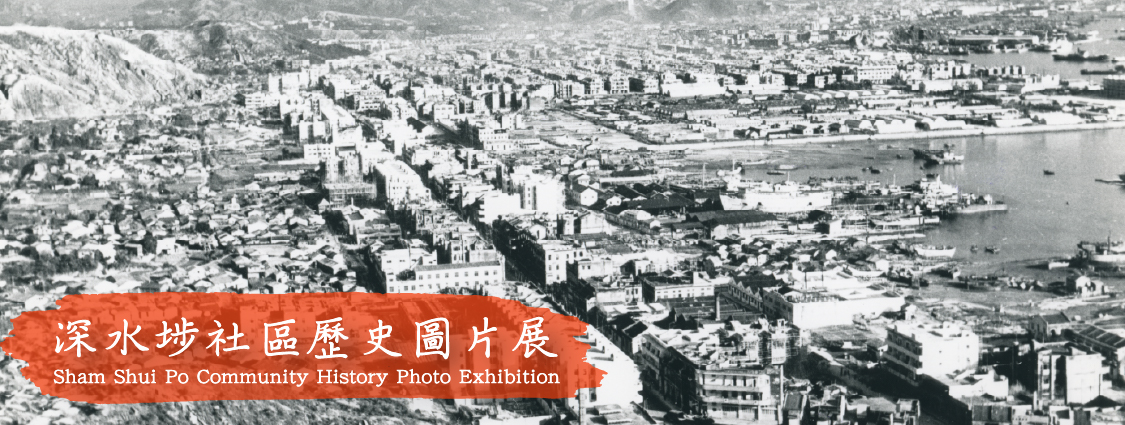
The exhibition of ‘Sham Shui Po Community History Photo’, held from 5 August 2016 to 26 April 2017 at the Lei Cheng Uk Han Tomb Museum, illustrates the history and development of the district through historical photos and maps, offering the public a glimpse of the growth of Sham Shui Po District.
This collection presents the contents and materials of the above exhibition, and supplementary materials subsequently provided by the Hong Kong Museum of History to let the general public to relive the story of Sham Shui Po community.

About the Collection
Sham Shui Po District, which roughly includes Mei Foo, Lai Chi Kok, Cheung Sha Wan, Central Sham Shui Po, Shek Kip Mei, Yau Yat Chuen, and West Kowloon Reclamation Area and Stonecutters Island, is in the northwest of the Kowloon Peninsula, and has experienced significant changes throughout its history. Although Sham Shui Po is an old district, it is a lively place with its own characteristics. The discovery of the Lei Cheng Uk Han Tomb proves that this area was inhabited from as early as the period of Eastern Han dynasty (CE 25-220). In the Gazetteer of the Xin'an County (Xin'an Xian Zhi) compiled during 1796-1820, the Chinese name of Sham Shui Po was written as ‘深水莆’, while the Chinese character for ‘Po’, written as ‘埔’ or ‘步’ can be seen in other records. At that time, this area was home to several villages, one of which was Sham Shui Po. It was in the vicinity of the present Yu Chau Street and Pei Ho Street, while villages such as Cheung Sha Wan, So Uk and Lei Uk were scattered nearby. As there used to be a jetty near the village, beside the rock of Tai Kok Tsui, the deep water provided berths for vessels, so was named Sham Shui Po (literally ‘Deep Water Jetty’).
Sham Shui Po District boasts a rich history in terms of industrial and commercial activities, housing development and military establishments etc., which yielded many historical episodes and valuable artefacts. Many of these were significant events closely related to the development of Hong Kong.
The exhibition of ‘Sham Shui Po Community History Photo’, held from 5 August 2016 to 26 April 2017 at the Lei Cheng Uk Han Tomb Museum, illustrates the history and development of the district through historical photos and maps, offering the public a glimpse of the growth of Sham Shui Po District.
This collection presents the contents and materials of the above exhibition, and supplementary materials subsequently provided by the Hong Kong Museum of History to let the general public to relive the story of Sham Shui Po community.