Chinoiserie was a fashion that swept across Europe during the 17th and 18th centuries, embodying Westerners’ fantasies about the Orient. In the 1980s, Gangcai manufacturers sensed the exoticism in the West and revived this trend again, producing chinoiserie Gangcai that proved highly popular in America. Chinoiserie patterns come in diverse forms, though mostly drawing inspiration from the oriental world centred around China, while also encompassing elements from Japan, Korea, South and Southeast Asia. Take, for instance, the Gangcai pattern named 'Oriental Paradise' depicting scenes of Orientals enjoying mountain excursions and water activities. This imagery originally stemmed from the impressions of a European painter during his travels in Southeast Asia between the 19th and 20th centuries, expressing the European perception of the exotic and mystic Orient. It combines folk customs and landscapes of China and Southeast Asia, and incorporating fantasies and romances. David K. S. Ho, owner of a porcelain factory, commissioned artist Lee Ying-sang to adapt the original sketches with further additions, and one can see unconventional flying dragons or fairies beneath a bridge over a stream, or flowers and butterflies larger than human figures, and small boats styled like gondolas in Venice! Such compositions are quite surreal when view from contemporary aesthetic. These patterns were applied to various vessel forms, with minimalist colour scheme and strikingly stylish.
Chinoiserie porcelain—
Plate with gilded Oriental Paradise design on black-groundPlate with gilded Oriental Paradise design on black-ground (part); the figures look like deities are sitting on a swing (1998, blank produced, glazed and embellished with genuine gold by Wah Mou; collection of Hong Kong Heritage Museum)
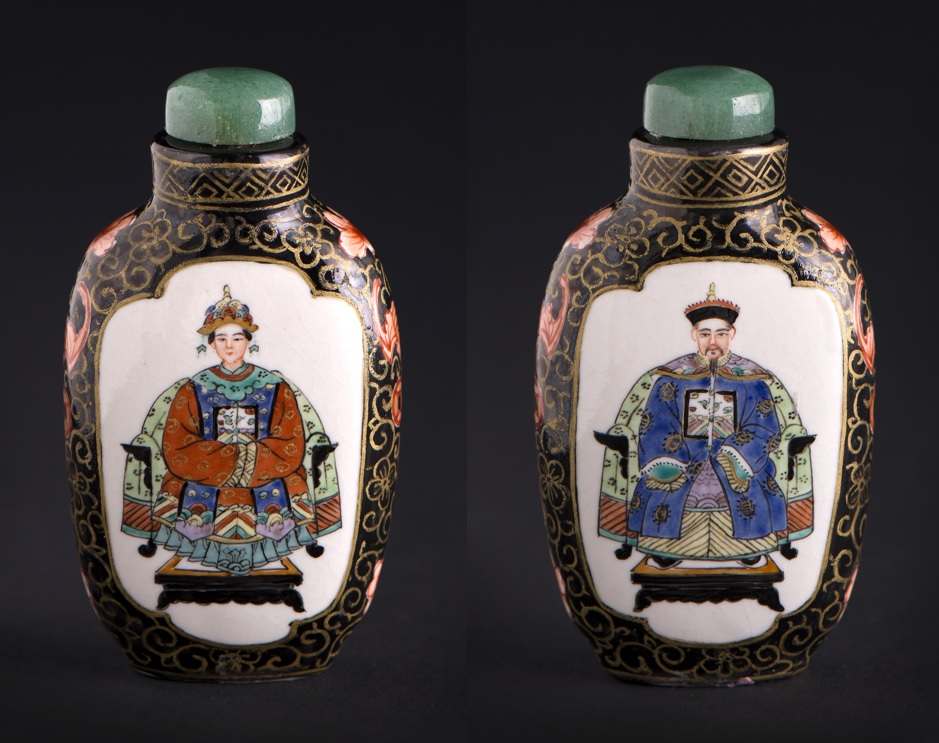
Snuff bottle with Chinese ancestor portrait in panels against gold embellished black-ground (1989, painted and collected by Lee Siu Man)
Plate with scenes of village watchtowers and figures in Chinoiserie style (1980s, painted and collected by Yuet Tung China Works)Large plate with patterns in Imari style (1988, painted by Wing Tai; collection of Hong Kong Heritage Museum)
Chinoiserie was a fashion that swept across Europe during the 17th and 18th centuries, embodying Westerners’ fantasies about the Orient. In the 1980s, Gangcai manufacturers sensed the exoticism in the West and revived this trend again, producing chinoiserie Gangcai that proved highly popular in America. Chinoiserie patterns come in diverse forms, though mostly drawing inspiration from the oriental world centred around China, while also encompassing elements from Japan, Korea, South and Southeast Asia. Take, for instance, the Gangcai pattern named 'Oriental Paradise' depicting scenes of Orientals enjoying mountain excursions and water activities. This imagery originally stemmed from the impressions of a European painter during his travels in Southeast Asia between the 19th and 20th centuries, expressing the European perception of the exotic and mystic Orient. It combines folk customs and landscapes of China and Southeast Asia, and incorporating fantasies and romances. David K. S. Ho, owner of a porcelain factory, commissioned artist Lee Ying-sang to adapt the original sketches with further additions, and one can see unconventional flying dragons or fairies beneath a bridge over a stream, or flowers and butterflies larger than human figures, and small boats styled like gondolas in Venice! Such compositions are quite surreal when view from contemporary aesthetic. These patterns were applied to various vessel forms, with minimalist colour scheme and strikingly stylish.
Chinoiserie porcelain—
Plate with gilded Oriental Paradise design on black-groundPlate with gilded Oriental Paradise design on black-ground (part); the figures look like deities are sitting on a swing (1998, blank produced, glazed and embellished with genuine gold by Wah Mou; collection of Hong Kong Heritage Museum)
Snuff bottle with Chinese ancestor portrait in panels against gold embellished black-ground (1989, painted and collected by Lee Siu Man)
Plate with scenes of village watchtowers and figures in Chinoiserie style (1980s, painted and collected by Yuet Tung China Works)Large plate with patterns in Imari style (1988, painted by Wing Tai; collection of Hong Kong Heritage Museum)