Since the late Ming and early Qing dynasties in the 17th century, Chinese porcelain had long been favoured by and integral to the daily lives of European aristocracy. As for the 20th century, Gangcai had been exporting to European and American markets, serving as day-to-day tableware and ornaments used in everyday life. At the same time, some types of porcelain wares underwent transformation for alternate usage, expanding beyond their original functions, for instance, porcelain saucers were encased in tin or copper to serve as ashtrays to meet the trends in contemporary American lifestyle. Drilling holes into the painted porcelain vases, jars or pillows, fitting in wires and light bulbs with lampshades, and they are turned into lighting appliances in Western households. A porcelain fish tank with a piece of glass put on top, or mounting it on a traditional Chinese wooden base, and it is transformed into a coffee table or dining table. Setting a set of seven-piece porcelain candy box into a rotating wooden block made by a carpenter, and a Lazy Susan for snacks or Indian spices was born. Adorning porcelain wares with refined metal bases and pairs of handles or lids, these pieces resemble exquisite jewellery adorning noble homes. The re-processing of the Gangcai pieces made them more valuable, letting them serve as elegant accents to daily lives of westerners while still being practical, such are the innovative crossovers between Gangcai with metallurgy, carpentry and lighting fixtures manufacturers.
Fish tank in new floral patterns with Japanese paint: a piece of glass put on top of the fish tank and mounted on a traditional Chinese wooden base, it then transforms into an exotic coffee table. (Painted by Art Sheen; collection of Lee Woon Hung)
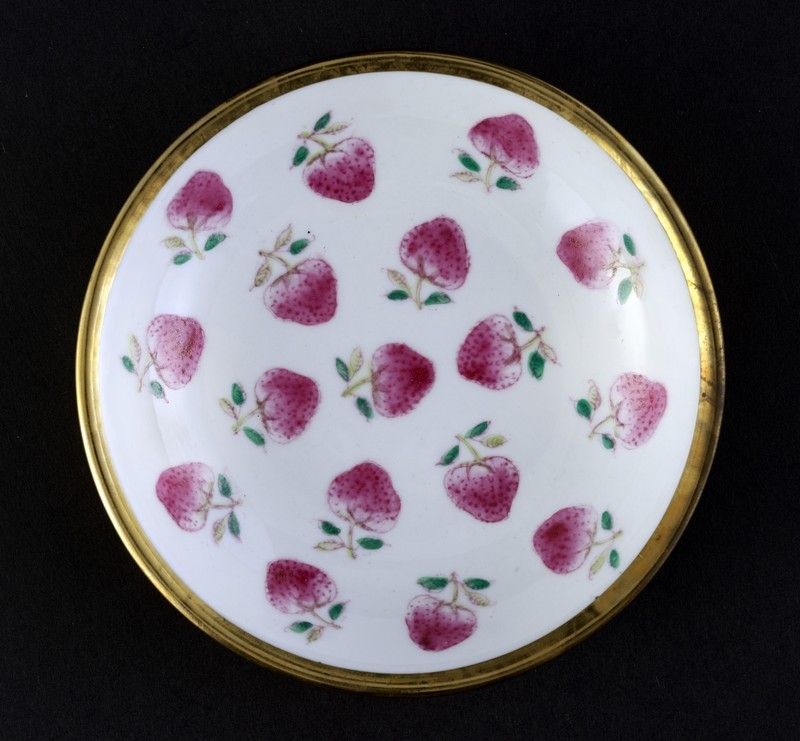
Copper-encased ashtray with strawberry design (top / bottom) (1960–2000, commissioned by Sudi and painted by Yuet Tung China Works; collection of Yuet Tung China Works)
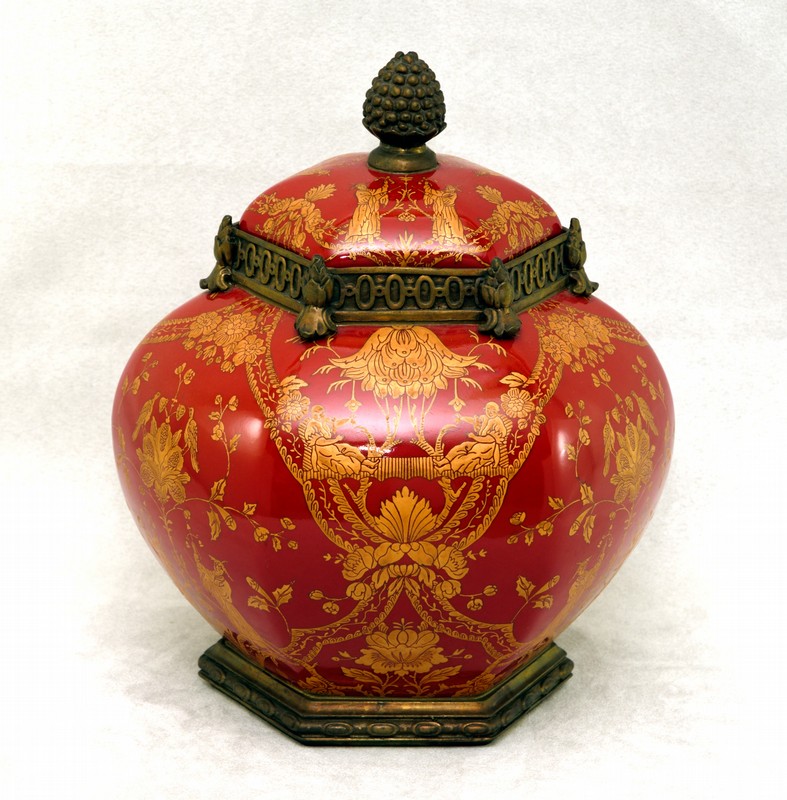
Covered jar in coral red: the jar can store confectioneries. Adorned with metal ornaments for a refined style. (Painted by Wah Tung China Arts; collection of Wah Tung China Arts)Covered jar with gilded copper ornamentation and mandarin design in Qianlong (1999, hand-painted by Zhang Quan; Blank by Wah Mou; collection of Wah Tung China Arts)
Seven-piece tray set with bat and deer design: this Lazy Susan for snacks and Indian spice is set in a rotating wooden block. (1960s; Hand-painted by Sin Cheung Lun; collection of Yuet Tung China Works)
Since the late Ming and early Qing dynasties in the 17th century, Chinese porcelain had long been favoured by and integral to the daily lives of European aristocracy. As for the 20th century, Gangcai had been exporting to European and American markets, serving as day-to-day tableware and ornaments used in everyday life. At the same time, some types of porcelain wares underwent transformation for alternate usage, expanding beyond their original functions, for instance, porcelain saucers were encased in tin or copper to serve as ashtrays to meet the trends in contemporary American lifestyle. Drilling holes into the painted porcelain vases, jars or pillows, fitting in wires and light bulbs with lampshades, and they are turned into lighting appliances in Western households. A porcelain fish tank with a piece of glass put on top, or mounting it on a traditional Chinese wooden base, and it is transformed into a coffee table or dining table. Setting a set of seven-piece porcelain candy box into a rotating wooden block made by a carpenter, and a Lazy Susan for snacks or Indian spices was born. Adorning porcelain wares with refined metal bases and pairs of handles or lids, these pieces resemble exquisite jewellery adorning noble homes. The re-processing of the Gangcai pieces made them more valuable, letting them serve as elegant accents to daily lives of westerners while still being practical, such are the innovative crossovers between Gangcai with metallurgy, carpentry and lighting fixtures manufacturers.
Fish tank in new floral patterns with Japanese paint: a piece of glass put on top of the fish tank and mounted on a traditional Chinese wooden base, it then transforms into an exotic coffee table. (Painted by Art Sheen; collection of Lee Woon Hung)
Copper-encased ashtray with strawberry design (top / bottom) (1960–2000, commissioned by Sudi and painted by Yuet Tung China Works; collection of Yuet Tung China Works)
Covered jar in coral red: the jar can store confectioneries. Adorned with metal ornaments for a refined style. (Painted by Wah Tung China Arts; collection of Wah Tung China Arts)Covered jar with gilded copper ornamentation and mandarin design in Qianlong (1999, hand-painted by Zhang Quan; Blank by Wah Mou; collection of Wah Tung China Arts)
Seven-piece tray set with bat and deer design: this Lazy Susan for snacks and Indian spice is set in a rotating wooden block. (1960s; Hand-painted by Sin Cheung Lun; collection of Yuet Tung China Works)