About this siteDesigns taking Ideas from many PlacesEvents Recap
Designs taking Ideas from many Places
20th Century Hong Kong Painted Porcelains—Gangcai
BROWSE BY
RECENTLY VISITED
{{removeNBSP(item.name)}}
20th Century Hong Kong Painted Porcelains—Gangcai
BROWSE BY:
RECENTLY VISITED
{{item.name}}
Designs taking Ideas from many Places
Gangcai grew from the fusion of multiple arts and cultures, Gangcai during the 20th century is not a specific type of painted porcelain with a particular pattern, but rather refers to a whole category of painted porcelain that reflects the diverse and distinctive characteristics of Hong Kong along with its unique historical context and geopolitical circumstances. Throughout the 20th century, Gangcai underwent constant transformation, in how the porcelain wares were used, painted patterns, artistic styles, and decoration techniques, all diverged from patterns used in Gangcai drew heavily from Guangcai at first, as Gangcai developed, numerous new pattern designs emerged, featuring fresh styles distinct from those produced in Chinese Mainland. Following the establishment of the People’s Republic of China in 1949, innovative designs emerged within the industry, referred to as 'new floral patterns'. Evidence from product catalogues of local porcelain factories, artefacts, manuscripts, and pattern templates confirms that Gangcai indeed came up with a substantial number of new designs. These patterns demonstrate that the industry did not merely follows traditional patterns but actively create new variations from established materials and even broke conventions to innovate. Themes and styles of Gangcai synthesise the characteristics from all corners of the world, as well as transcending time while integrating with the porcelain painting techniques of each. It even combines porcelain with other materials to create crossover craft masterpieces spanning across different media, significantly pushing the boundaries of painted porcelain. Key characteristics of Gangcai are briefly illustrated with examples below:
Designs taking Ideas from many Places
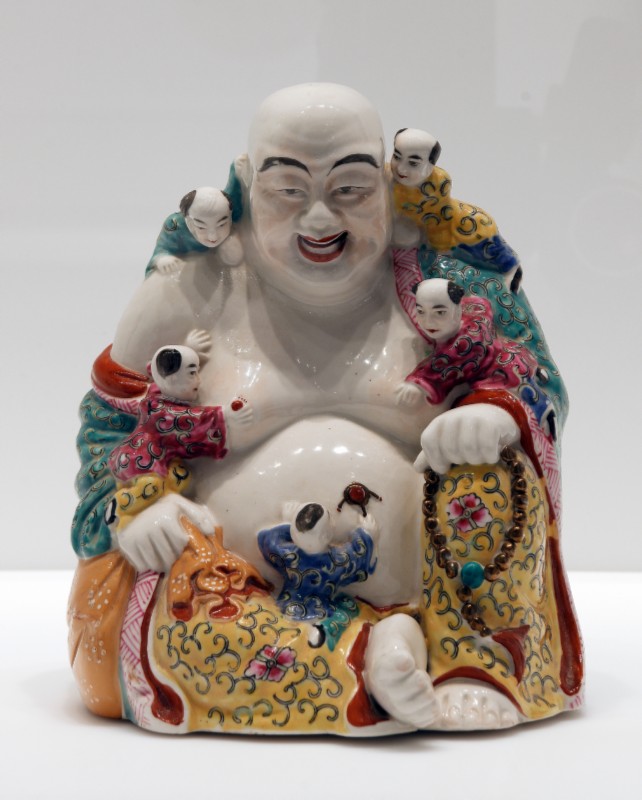
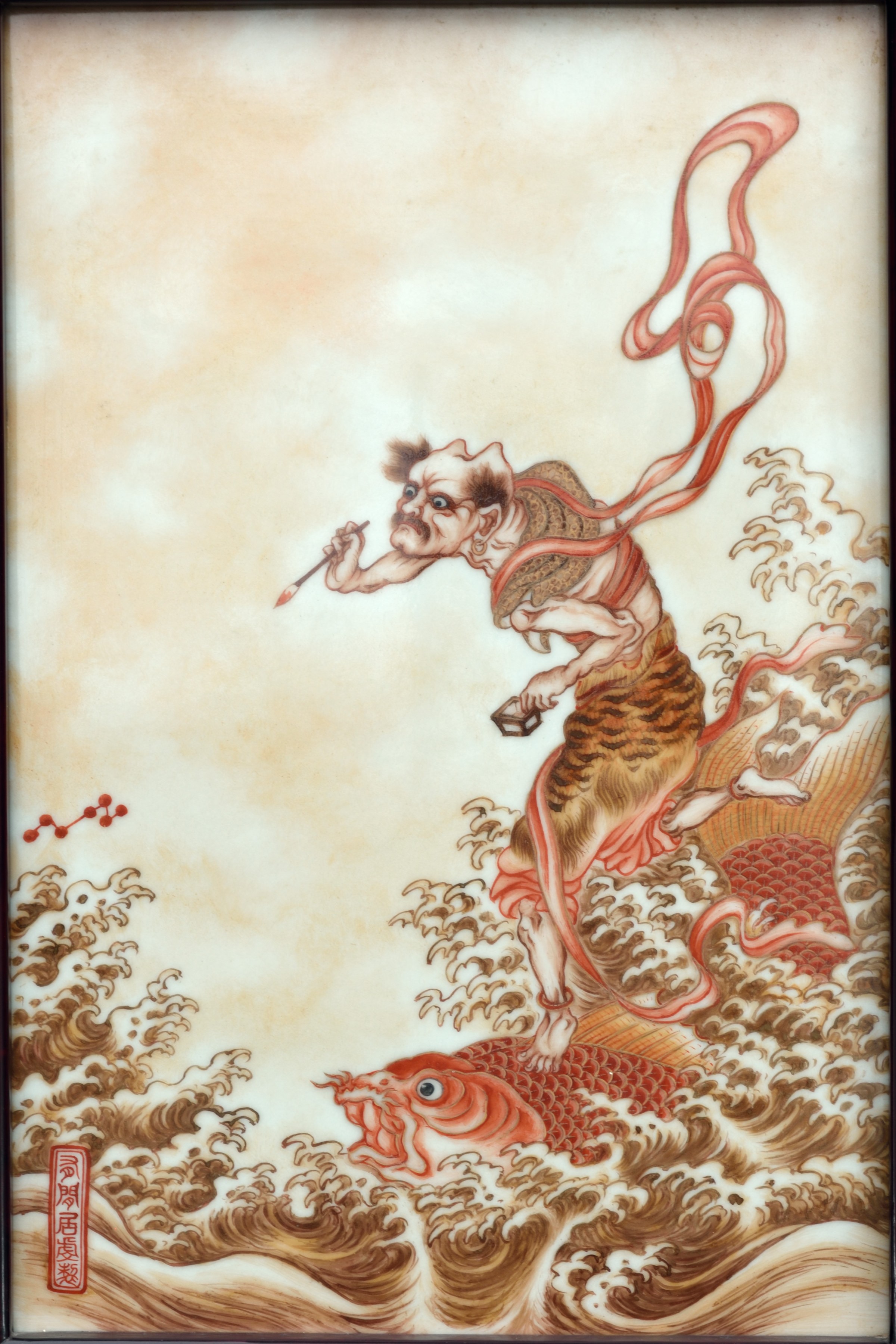
Gangcai in the 20th century possessed remarkable adaptability, embracing diverse regional cultures, ideologies, and religions with open arms. Reflecting and projecting vibrant hues of its myriad elements and characteristics like mirror balls. Examples abound: Gangcai pieces with religious themes of Taoism, Buddhism or Christianity were not uncommon, and there are also some with Islamic or Jewish themes. Another example was a plate commissioned for a client from the Middle East featured Guangcai-style borders and patterns, but bearing Persian script at the centre, with customary green paint replaced by Islamic-inspired blue. There was also a plate depicting Moses delivering the Ten Commandments for a Jewish client, adorned with Canton Rose and floral-fruit borders.
Painted porcelain with Jewish theme: Plate with scene of Moses announcing the Ten Commandments design in guangcai style (1986, layout design by Lam Siu Woo; collection of Yuet Tung China Works)Painted porcelain with Buddhist theme: Figurine of Buddha with five children decorated with tendril scroll pattern in houcai style (1960s, painted and collected by Yuet Tung China Works)
Painted porcelain with Christian theme: Plate with scene of the Passion of Jesus (painted and collected by Tao Fong Shan Christian Centre)Painted porcelain with Taoist theme: Plaque with "Kui Xing (Champion Star) pointing the dipper" (Late 1980s, painted by Lee Siu Man; collection of Hong Kong Heritage Museum)
Painted porcelain with Muslim theme: Large crackle glazed plate in guangcai style with Persian inscription and designs of figures, flowers and birds embellished in gold on blue-ground (1990s, painted by Wah Tung China; collection of Hong Kong Heritage Museum)
Gangcai grew from the fusion of multiple arts and cultures, Gangcai during the 20th century is not a specific type of painted porcelain with a particular pattern, but rather refers to a whole category of painted porcelain that reflects the diverse and distinctive characteristics of Hong Kong along with its unique historical context and geopolitical circumstances. Throughout the 20th century, Gangcai underwent constant transformation, in how the porcelain wares were used, painted patterns, artistic styles, and decoration techniques, all diverged from patterns used in Gangcai drew heavily from Guangcai at first, as Gangcai developed, numerous new pattern designs emerged, featuring fresh styles distinct from those produced in Chinese Mainland. Following the establishment of the People’s Republic of China in 1949, innovative designs emerged within the industry, referred to as 'new floral patterns'. Evidence from product catalogues of local porcelain factories, artefacts, manuscripts, and pattern templates confirms that Gangcai indeed came up with a substantial number of new designs. These patterns demonstrate that the industry did not merely follows traditional patterns but actively create new variations from established materials and even broke conventions to innovate. Themes and styles of Gangcai synthesise the characteristics from all corners of the world, as well as transcending time while integrating with the porcelain painting techniques of each. It even combines porcelain with other materials to create crossover craft masterpieces spanning across different media, significantly pushing the boundaries of painted porcelain. Key characteristics of Gangcai are briefly illustrated with examples below:
Designs taking Ideas from many Places
Gangcai in the 20th century possessed remarkable adaptability, embracing diverse regional cultures, ideologies, and religions with open arms. Reflecting and projecting vibrant hues of its myriad elements and characteristics like mirror balls. Examples abound: Gangcai pieces with religious themes of Taoism, Buddhism or Christianity were not uncommon, and there are also some with Islamic or Jewish themes. Another example was a plate commissioned for a client from the Middle East featured Guangcai-style borders and patterns, but bearing Persian script at the centre, with customary green paint replaced by Islamic-inspired blue. There was also a plate depicting Moses delivering the Ten Commandments for a Jewish client, adorned with Canton Rose and floral-fruit borders.
Painted porcelain with Jewish theme: Plate with scene of Moses announcing the Ten Commandments design in guangcai style (1986, layout design by Lam Siu Woo; collection of Yuet Tung China Works)Painted porcelain with Buddhist theme: Figurine of Buddha with five children decorated with tendril scroll pattern in houcai style (1960s, painted and collected by Yuet Tung China Works)
Painted porcelain with Christian theme: Plate with scene of the Passion of Jesus (painted and collected by Tao Fong Shan Christian Centre)Painted porcelain with Taoist theme: Plaque with "Kui Xing (Champion Star) pointing the dipper" (Late 1980s, painted by Lee Siu Man; collection of Hong Kong Heritage Museum)
Painted porcelain with Muslim theme: Large crackle glazed plate in guangcai style with Persian inscription and designs of figures, flowers and birds embellished in gold on blue-ground (1990s, painted by Wah Tung China; collection of Hong Kong Heritage Museum)