About this siteVintage Porcelain with New DesignsEvents Recap
Vintage Porcelain with New Designs
20th Century Hong Kong Painted Porcelains—Gangcai
BROWSE BY
RECENTLY VISITED
{{removeNBSP(item.name)}}
20th Century Hong Kong Painted Porcelains—Gangcai
BROWSE BY:
RECENTLY VISITED
{{item.name}}
Vintage Porcelain with New Designs
At the height of Gangcai’s popularity it was trendy to produce vintage-style porcelain with new designs, mixing playful elements fashionable in USA into the design and decoration of painted porcelain, started with freely mixing of traditional motifs to new styles from combining Eastern and Western elements in later time, resulting in new fashion of porcelain that is both unorthodox and chic, classical yet modern.
Regarding painting techniques, Gangcai favoured thick painting, factories combined traditional Jiangxi powdered colour techniques with proprietary formulations to build up thick layers of pigment. During this period, to cater to foreign clients’ preference for porcelain bearing signs of age, various post-firing treatments were applied to finished pieces. These included full-body matting, acid etching, or staining, collectively known as the distressing. Wah Tung pioneer in for distressing to mimic antiques without discolouration by chemical methods.
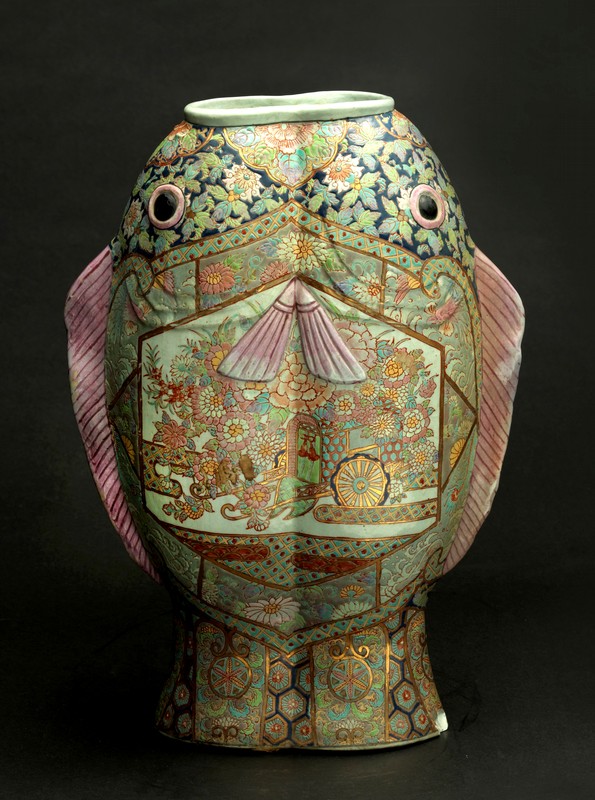
There were many such vintage-style porcelain with new designs, such as a double fish vase by Art Sheen which combined traditional form with new decorative elements. Double fish is a traditional auspicious motif, but the theme ornaments on the fish body was influenced by Japanese paintings. The colour used was more restrained from the vivid tone typical in traditional Guangcai to make them more suitable to adorn the typical American homes. This piece combined the traditional Chinese style with novel influence from Japanese and American cultures, covered with the thick enamel from Gangcai, blending the artistic elements with diverse origin. This seamless and harmonic integration captures the distinctive character of 20th century Hong Kong with our adaptability and versatility.
Double fish vase in famille rose and gilded, with Japanese pattern (1970s to 1980s; Collection of Hong Kong Heritage Museum)Jar with embroidery patterns in lozenge panels in Imari style (Late 1980s, blank by Majestic Chemical Artcraft Manufacture, painted by Wing Hing Painted Porcelain Factory; Collection of Hong Kong Heritage Museum)
At the height of Gangcai’s popularity it was trendy to produce vintage-style porcelain with new designs, mixing playful elements fashionable in USA into the design and decoration of painted porcelain, started with freely mixing of traditional motifs to new styles from combining Eastern and Western elements in later time, resulting in new fashion of porcelain that is both unorthodox and chic, classical yet modern.
Regarding painting techniques, Gangcai favoured thick painting, factories combined traditional Jiangxi powdered colour techniques with proprietary formulations to build up thick layers of pigment. During this period, to cater to foreign clients’ preference for porcelain bearing signs of age, various post-firing treatments were applied to finished pieces. These included full-body matting, acid etching, or staining, collectively known as the distressing. Wah Tung pioneer in for distressing to mimic antiques without discolouration by chemical methods.
There were many such vintage-style porcelain with new designs, such as a double fish vase by Art Sheen which combined traditional form with new decorative elements. Double fish is a traditional auspicious motif, but the theme ornaments on the fish body was influenced by Japanese paintings. The colour used was more restrained from the vivid tone typical in traditional Guangcai to make them more suitable to adorn the typical American homes. This piece combined the traditional Chinese style with novel influence from Japanese and American cultures, covered with the thick enamel from Gangcai, blending the artistic elements with diverse origin. This seamless and harmonic integration captures the distinctive character of 20th century Hong Kong with our adaptability and versatility.
Double fish vase in famille rose and gilded, with Japanese pattern (1970s to 1980s; Collection of Hong Kong Heritage Museum)Jar with embroidery patterns in lozenge panels in Imari style (Late 1980s, blank by Majestic Chemical Artcraft Manufacture, painted by Wing Hing Painted Porcelain Factory; Collection of Hong Kong Heritage Museum)